Dozens killed in Saudi strikes in Houthi-held region in Yemen, Houthis say
Houthi authorities said Sunday that Saudi strikes killed 33 people, many of them women and children, in Yemen’s Sanaa province, as deaths mount in the country’s revived civil war.
The United Nations says more than 1,600 people have been killed and more than 300,000 displaced since fighting resumed in the impoverished country.
The death toll from the Saudi-led coalition’s strikes on Al-Shariya village located east of Yemen’s capital Sanaa has risen to 33, with 39 people wounded, Houthi health ministry spokesman Anees Alasbahi said in a post on X.
The Houthis’ Saba news agency said on Saturday that operations to recover victims from the rubble were ongoing and that “aircraft targeted paramedics with two strikes.”
“According to the near-final figures, the dead include 12 men, 8 women and 13 children, while the injured include 16 men, 10 women and 13 children,” Alasbahi said.
Saudi Arabia, fighting in Yemen in support of the internationally-recognized government, has not commented on the report. The Saudi-led coalition in a statement on Saturday said it had intercepted and destroyed a Houthi missile launched towards Riyadh province.
The Iran-backed Houthis, meanwhile, said they had launched multiple missile and drone attacks against Saudi troops and infrastructure both in the Gulf kingdom and Yemen.
Yemen slipped back into war between the Houthis and the Saudi-backed government in July after years of relative calm, opening a new front in the conflict in the Middle East.
Since then, Saudi Arabia has regularly bombed Houthi positions, while the group has expanded its attacks against the oil-rich kingdom.
By AFP
U.S. forces disabled commercial vessel in Gulf of Oman, CENTCOM says
U.S. forces disabled a commercial vessel in the Gulf of Oman on Saturday after the ship’s civilian crew ignored repeated warnings and attempted to violate the naval blockade against Iran multiple times, U.S. Central Command said.
A U.S. military aircraft fired precision munitions at the stern of St.Kitts-flagged M/V Huda, which disabled the ship after the crew was directed to abandon targeted spaces. The cargo vessel tried to depart regional waters after visiting an Iranian port, CENTCOM said.
“All mariners transiting near Iranian coastal areas or surrounding waters are advised to heed blockade warnings from U.S. forces,” CENTCOM said.
Earlier Saturday, CENTCOM said “strict enforcement” of the U.S. blockade on Iranian ports in the Strait of Hormuz continues.
Iran established a chokehold on the strait, a vital strategic waterway in global trade, at the beginning of the war, and has claimed attacks on tankers. The U.S. says its blockade had redirected 144 commercial vessels through the end of October.
-CBS/AP
U.S. launches new task force to disrupt Iranian ground shipping routes
In what the U.S. military is calling an expansion of the naval blockade, U.S. Central Command announced a new task force Saturday aimed at disrupting the illegal shipment of prohibited items like military technology or illegal revenue streams over ground transportation routes.
“The establishment of Task Force Iron Gate reinforces the success of our ironclad blockade against Iran at sea,” U.S. Central Command chief Adm. Brad Cooper said in a statement. “Strengthening CENTCOM’s collaboration with U.S. interagency partners will further constrain Iran’s ability to finance terrorism, rebuild weapons factories, and replenish their military.”
The U.S. said the task force will be made up of about 20 civilian and military personnel, based in Florida, and will be tasked with the goal of “preventing the movement of advanced weapons systems, dual-use technologies, sanctioned materials, and illegal revenue streams across Iran’s land borders and the Caspian Sea.”
The announcement made no mention of how the task force would be carrying out its goal, including whether any military operations will be involved.
China, Iran’s largest trade partner, has taken to conducting commerce over land, especially by train across central Asia due to the blockade on Iranian ports. The U.S. said the blockade has prevented some $25 billion in Iranian crude oil from being sold, much of it in Asia.
In addition to China, Iran has conducted large amounts of trade over land and via the Caspian Sea with Russia. The landlocked Caspian Sea has proven especially advantageous with a direct route between southwest Russia and northern Iran. Tehran is located just 80 miles south of the Caspian Sea.
Whether any U.S. ships could take to the Caspian Sea was again unclear. CBS News has reached out to the White House for more details.
By Mark Osborne
Iran’s Revolutionary Guard lifts self-imposed missile-range limit
Iran’s Revolutionary Guard says it has lifted a self-proclaimed limit of 1,200 miles on the range of its ballistic missiles, suggesting the country may seek to develop missiles capable of reaching more distant targets amid fears of renewed all-out war.
The comments by the spokesman of Iran’s paramilitary Revolutionary Guard came days after the country’s supreme leader, Ayatollah Mojtaba Khomeini, warned “any kind and level of threat” from the U.S. or Israel would face a response without geographic limits.
Asked at a Tehran press conference about the limit on missile ranges, Gen. Hossein Mohebbi said, “That restriction has been lifted for us.”
He did not say whether Iran had missiles capable of exceeding the limit, saying only Iran would “demonstrate these capabilities in practice” rather than make statements.
Iran is not known to have missiles that can go beyond the 1,200-mile limit — a range that puts parts of Greece and the Balkans, the entire Arabian Peninsula, the Levant and most of Egypt within reach. However, U.S. officials have said technology from Iran’s space program can be repurposed to build intercontinental ballistic missiles.
The Iranian military, meanwhile, said a tanker east of the Strait of Hormuz had hit a naval mine and caught fire. It did not identify the nationality or destination of the tanker, which it said had turned off its navigational beacon and was sailing in a “prohibited area.”
By The Associated Press
22 killed in Saudi strikes on Yemen’s Sanaa province, Houthis say
Saudi strikes killed 22 people, most of them women and children, in Yemen’s Sanaa province, as deaths mount in the country’s civil war, Houthi media said on Saturday.
More than 1,600 people have been killed and more than 300,000 displaced since fighting resumed in the impoverished country, according to the U.N.
“The number of victims of the Saudi enemy warplane massacre in the Al-Shariyah area … has risen to 22 citizens, most of them children and women, while the number of wounded has risen to 30,” the Houthis’ Saba news agency said.
The Iran-backed group’s Al-Masirah TV provided the same toll.
Saba said earlier Saturday that operations to recover victims from the rubble were ongoing and that “aircraft targeted paramedics with two strikes.”
The Saudi-led coalition in a statement on Saturday said it had intercepted and destroyed a Houthi missile launched toward Riyadh province.
On Friday, an attack on a market in Taiz province killed 30 people. The Houthis said Saudi airstrikes were to blame, while Yemen’s government forces accused the Iran-backed group of having fired a ballistic missile at the site.
AFP/CBS
Iranian army says forces learned from war with the U.S.
Iran’s military is “stronger” and more motivated than it was when the United States and Israel started the war in February, Iranian state media reported on Saturday, citing an army spokesman.
“Today, the Islamic Republic’s armed forces… having gained experience from direct confrontation with the United States and the Israeli regime, are on higher alert and are stronger than they were at the beginning of the war,” spokesman Mohammad Akraminia said, according to the state news agency IRNA.
“They now possess greater motivation, commitment, and self-confidence.”
CBS/AFP
Trump confirms U.S. carried out more “minor strikes” on Iran
President Trump confirmed on Friday the U.S. carried out “minor strikes” in Iran, after local state media reported missiles striking Qeshm Island on the Strait of Hormuz.
Speaking to reporters on Friday, Mr. Trump was asked whether the U.S. carried out more strikes on the island.
“I don’t want to talk about it,” the president said. “We do minor strikes. They built a little bit of an anti-aircraft device and we knocked it out in about 15 minutes, maybe 5.”
On Saturday, Iran’s Tasnim news agency reported that two missiles had struck Qeshm island, added that there was no official information on the damage. Iranian state television also reported two explosions on the island.
By Duarte Dias
White House offers up to $20 million reward for information on Iran’s nuclear program
The Trump administration is offering a reward of up to $20 million for information about Iran’s nuclear program, the U.S. military’s Central Command announced Friday.
The reward, which is being administered through the State Department’s Rewards for Justice national security program, also comes with “possible relocation” for the tipster.
The State Department said it is calling for “information about Iran’s nuclear program, including its facilities, equipment, and associated personnel, such as those in the scientific community, or the movement of any of the above.”
Since the U.S. launched its war with Iran in February, President Trump has repeatedly reiterated that Iran cannot obtain a nuclear weapon.
In its reward form, the State Department noted that according to the United Nations’ International Atomic Energy Agency, Iran’s uranium stockpile is believed to include uranium that has been enriched to 60% purity – “a level that is a short technical step from” the 90% level required to produce nuclear weapons.
“Iran is the only non-nuclear-weapon state to produce uranium at such a high enrichment level,” the State Department said in its Rewards for Justice post. “Experts estimate this quantity, if enriched further, could be enough for several nuclear weapons.”
Iran suspended IAEA inspections following the June 2025 strikes on Iranian nuclear facilities by the U.S. and Israel.
“The regime’s lack of compliance with the IAEA on safeguards obligations has led to the agency’s loss of ‘continuity of knowledge’ regarding Iran’s production and inventory of key components like centrifuges,” the State Department said Friday.
By Faris Tanyos
U.S. coordinates with Canada to target Iranian digital asset providers
The Treasury Department on Friday targeted several firms exchanging Iranian rials and other currencies for allegedly helping Tehran evade sanctions and fund its proxies.
Some of the providers dealt with Iranian cryptocurrency exchanges already sanctioned by Washington.
The latest targets were coordinated with the Canadian government as several of the individuals and entities named are based in Vancouver and Toronto.
“Anyone, anywhere in the world, who helps Tehran evade sanctions risks being held accountable,” State Department spokesperson Tommy Pigott said in a statement.
By The Associated Press
Rubio to likely face questions about Iran at G7 foreign ministers meeting
Secretary of State Marco Rubio is set to embark on his first post-midterm foreign trip to attend a Group of Seven foreign ministers meeting in France next week.
He’ll likely face questions about the Trump administration’s policies, namely in Iran, after huge Republican losses in elections that gave Democrats control of Congress.
The State Department said Friday that Rubio would travel to Paris to meet his counterparts from Britain, Canada, France, Germany, Italy and Japan on Monday and Tuesday.
By The Associated Press
Houthis say 30 people killed or wounded in Saudi strike on market
Yemen’s Iran-backed Houthis said Friday that a Saudi strike on a market in southwestern Yemen had killed or wounded 30 people.
The Houthis’ Saba news agency said the “horrific massacre” had “resulted in the martyrdom and injury of more than 30 citizens.”
The Houthis’ political bureau said in a statement carried by Saba: “It is regrettable that these documented Saudi crimes have become like a forgotten file in the drawers of the United Nations and the so-called international community.”
By Frank Andrews
Houthis accuse Saudi Arabia of killing and wounding “dozens of civilians” in attack on market
Yemen’s Iran-backed Houthi rebels said Friday that the Saudi-led coalition fighting on behalf of Yemen’s internationally recognized government had targeted a market in the southwest of the country, killing and wounding “dozens of civilians.”
Houthi military spokesperson Yahya Saree said in a post on X that Saudi aircraft struck the Al-Hadara market in the Taiz governorate on Friday “with three airstrikes, leaving dozens of civilians dead and wounded.”
“These brutal crimes will not go unanswered and unpunished,” he added.
The Saudi-led coalition said Friday, meanwhile, that air defense systems had intercepted two ballistic missiles launched by the Houthis at Najran, a major city in southwest Saudi Arabia.
By Frank Andrews
Iran’s Revolutionary Guard say they have intercepted a U.S. drone in the Strait of Hormuz
Iran’s Revolutionary Guard claimed Friday to have destroyed another U.S. drone over Qeshm Island in the Strait of Hormuz.
In a statement carried by the state TV network IRIB, the IRGC said a U.S. MQ-1 drone was “intercepted and destroyed over Qeshm Island by the IRGC’s new advanced air defense system.”
The IRGC claimed this was the 16th American MQ-1 drone it had intercepted during the war, and the second in two days. Iranian forces have also claimed to have shot down other U.S. drones, including more than two dozen of the more advanced, and more expensive MQ-9 Reapers.
By Frank Andrews
Greek shipping firm says crew member killed in suspected missile strike on oil tanker
A seafarer was killed in an explosion caused by a suspected missile attack on an oil tanker Thursday in the Persian Gulf, a Greek company that manages the vessel said Friday.
The MT Velos Sapphire, a Marshall Islands-flagged tanker, which was not carrying cargo, was hit Thursday as it sailed toward Bahrain, management firm Velos Tankers said in a statement, according to Reuters.
“The company is greatly saddened to report the death of one of its seafarers, who was found fatally injured on board after having initially been reported missing in the aftermath of the explosion,” the statement said.
Velos said, according to Reuters, that no crew members were injured and they managed to extinguish a fire on the ship caused by the blast.
The vessel was brought to Khalifa Bin Salman Port in Bahrain, and the damage to its hull was still being assessed, Reuters said.
By Tucker Reals
Saudi-led coalition fighting Houthis in Yemen says drone intercepted in Mecca region
The Saudi-led coalition fighting the Iran-backed Houthis said Friday that it had intercepted a drone in the region of Mecca, Islam’s holiest city, following repeated attacks on Saudi Arabia by the Yemeni rebels.
“Interception and destruction of a drone in the Mecca region,” Turki al-Malki, the coalition’s spokesman, wrote on X, without elaborating.
Since the breakdown of a truce in July, Saudi Arabia has traded blows with the Houthis, who have retaliated with strikes on Saudi airports, energy infrastructure and military sites that killed at least 20 people in October.
The Houthis have repeatedly denied targeting the holy cities of Mecca or Medina in Saudi Arabia and said they would not do so.
On Thursday, the Saudi coalition said it intercepted a missile fired by the Houthis at the Medina region, a claim rejected by the Iranian proxy group as a “blatant and grave falsehood.”
CBS/AFP
Adviser to Iran’s supreme leader says Tehran now “one of the main architects” of Mideast security
The Iranian supreme leader’s adviser on international affairs, Aliakbar Velayati, said Friday that Iran was now “one of the main architects” of security in the Middle East.
Referring to how the U.S.-Iran war has changed the region in a series of posts on X, Velayati said that a “tsunami of geopolitical changes in West Asia swept up the Israeli and U.S. elections,” and that “Iran is now one of the main architects of the regional order, a reality that cannot be erased or replaced.”
Iran is a “bridge between the Persian Gulf, Central Asia, the Caucasus, and the Sea of Oman,” he added, saying that “any energy or transit corridor seeking to bypass us will either be costly or unstable.”
“The domino effect of crises, from Gaza to the Red Sea and from Lebanon to Iraq, has shown that regional security is indivisible,” Velayati said. “Either collective security is achieved, or everyone will experience collective insecurity.”
Iran’s Supreme Leader Mojtaba Khamenei has not been seen in public since being wounded in the strikes that killed his father on Feb. 28.
By Frank Andrews
Tanker hit by explosion in Strait of Hormuz, U.K. naval agency says
A tanker was hit by an explosion Thursday in the Strait of Hormuz, a British navy agency said Friday.
The master of a tanker leaving the Strait of Hormuz near Oman’s coast reported “an explosion at the waterline” of the vessel, the United Kingdom Maritime Trade Operations center said, adding that the crew were all safe and the ship was “still under its own power and is continuing on its voyage.”
Iran’s state media reported Thursday that five oil tankers and a tugboat had caught on fire in or near the strait after hitting sea mines. It was unclear if the UKMTO report was in relation to one of those incidents claimed by Iran.
Iran’s Islamic Revolutionary Guard Corps claimed Friday, in a statement carried by state media, that two more oil tankers had hit mines and caught on fire in or near the strait.
President Trump has accused Iran of lying about such incidents in an effort to drive up energy prices.
By Frank Andrews
Trump holds a phone call with Qatar’s emir, a key mediator in negotiations with Iran
President Trump called Qatari Emir Sheikh Tamim bin Hamad Al Thani to discuss efforts to end the U.S.-Iran war, a U.S. official confirmed to CBS News Friday, amid a diplomatic push to avoid a new round of major hostilities.
Their discussion, which the White House had not provided any information about by Friday morning, came as Iran’s top diplomat made his own calls Thursday to counterparts across the Persian Gulf aimed at maintaining “stability in the region” amid concerns in many Gulf capitals that Mr. Trump will order major new U.S. strikes.
Al Thani received a call from Mr. Trump, according to a statement from the emir’s office, during which the pair discussed “the latest regional developments, particularly diplomatic efforts aimed at de-escalating tensions in the region.”
The emir “emphasized the importance of continuing dialogue and relying on diplomatic means to settle disputes and prevent further escalation,” the statement said.
By Jennifer Jacobs
U.S. gas prices could soon dip below $4 a gallon. Why are fuel costs falling?
Motorists could soon see U.S. gas prices drop below $4 a gallon for the first time since July, according to energy experts.
Patrick De Haan, a petroleum analyst at price-tracking firm GasBuddy, told CBS News he expected the national average for gas, which the price-tracking firm put at $4.06 a gallon on Thursday and early Friday morning, to dip below the $4 threshold by next week. He also predicted diesel could fall below $6 a gallon by Thanksgiving.
Gas and diesel prices have both dropped over the last week, thanks largely to market expectations that the U.S. midterm election results would underscore public dissatisfaction with the Iran war and pile pressure on the Trump administration to make a deal to end the conflict, De Haan said.
“Oil prices have been falling in the run-up to the election,” he said. “My read is because there was optimism that after the midterms these problems would be addressed.”
Read more here.
By Mary Cunningham
Saudi-led coalition intercepts 2 missiles launched by Houthis
The Saudi-led coalition backing Yemen’s government said Friday that air defense systems had intercepted and destroyed two ballistic missiles launched by the Iran-backed Houthi rebels at Najran, a major city in southwest Saudi Arabia.
“Debris fell as a result of the interception, and damage assessment is underway,” the statement said.
By Brian Dakss
Iran says 2 tankers hit mines, caught fire in and near Strait of Hormuz
Iran’s Islamic Revolutionary Guard Corps said in a statement carried by state media Friday that two oil tankers hit mines and caught fire in or near the Strait of Hormuz, a day after Tehran claimed five other tankers had met similar fates.
“Two violating oil tankers — one east of the Strait of Hormuz and the other within the Strait itself — that attempted to transit via an unauthorized route struck mines,” the IRGC said in a statement, according to state news outlets.
“These two tankers had deactivated all their navigation and identification systems. Supported by the aggressive and terrorist U.S. military, they attempted to exit the Strait of Hormuz via an unauthorized path; however, upon striking mines, they caught fire and were immobilized,” the statement said.
On Thursday, Iranian media reported that five oil tankers and a tugboat caught fire in the Strait of Hormuz in similar incidents.
There has been no confirmation of any of the incidents from maritime officials, and President Trump has accused Iran of making up such attacks to drive up global energy prices.
A U.K. naval agency said earlier this week, however, that despite repeated assurances from the U.S. that shipping lanes through the strait are open and safe, there were at least 30 attacks on commercial vessels in the region during October alone, a record high.
Since the war began with joint U.S.-Israeli strikes on Iran on Feb. 28, Tehran has sought to control traffic through the strait, a key passage through which, before the war, about a fifth of global crude oil supplies would typically pass. In response, the U.S. imposed a blockade on Iranian ports.
The U.S. military has escorted tankers through the strait, which, along with other routes has helped bring shipments from the Gulf back up to or at least near to pre-war levels, but ships continue coming under attack.
CBS/AFP
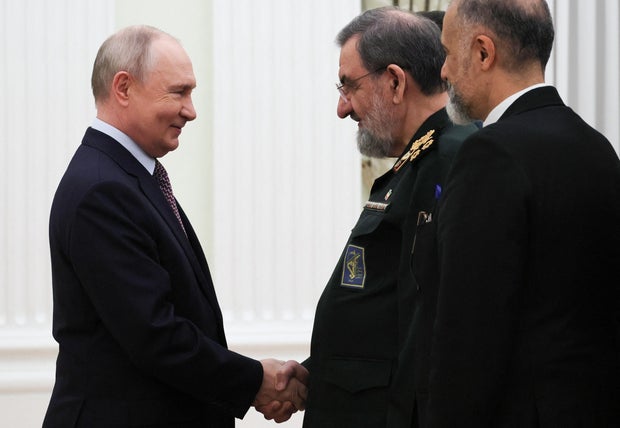
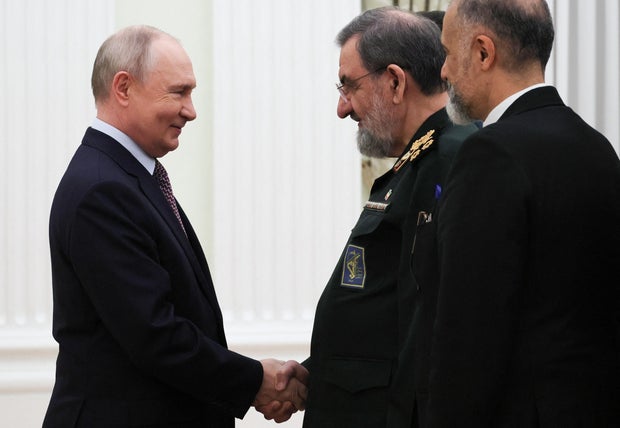
Putin and Iran’s security chief discuss building an oil pipeline from Russia to Iran
Russian President Vladimir Putin met Iranian security chief Mohsen Rezaei in Moscow Thursday to discuss strengthening ties between the two countries, including with the potential construction of a pipeline for Iran to import Russian gas.
Speaking with journalists after their meeting, Rezaei, secretary of Iran’s Supreme National Security Council, called it “an extremely important exchange,” according to the Iranian embassy in Moscow.
“During the meeting with Mr. Vladimir Putin, discussions were held regarding the construction of gas pipelines from Russia to Iran,” Rezaei was quoted as saying by Iranian state TV.
He noted the aim was to enable Iran “to address its own gas shortages while also facilitating the sale of Russian gas to neighboring countries.”
Alexey Babushkin/Pool/AFP via Getty Images
Despite being a major producer, Iran has long suffered natural gas shortages, which have been exacerbated by the war with the United States and Israel.
During the most intense phase of the fighting, which lasted nearly 40 days, the U.S. and Israel struck key Iranian infrastructure including natural gas refineries, according to Tehran.
CBS/AFP
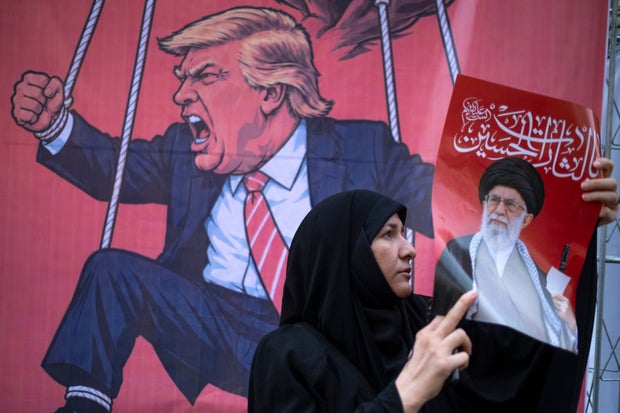
Trump touts imminent decision on whether he’ll order new strikes on Iran
President Trump said Thursday that people will soon know his decision on whether to order a new round of U.S. strikes on Iran.
Mr. Trump told reporters in the Oval Office that he believed it would take Iran 25 years to rebuild the country from the damage already inflicted during the war.
The president said he didn’t want to bring further destruction to the country, but he may not have a choice.
Mr. Trump kept the possibility of a major new U.S. assault on Iran on the table in the run-up to the midterm elections this week, but hadn’t renewed the threat since his Republican Party’s dismal performance in the vote, which he acknowledged was, at least in part, a repudiation of the war.
Morteza Nikoubazl/NurPhoto/Getty
Mr. Trump told the Financial Times newspaper on Tuesday evening, as U.S. ballots were counted, that he had no immediate plans to order new strikes on Iran.
By Frank Andrews