Mideast crisis “largest threat” to energy security ever, world energy body says
The crisis in the Middle East sparked in February by the U.S and Israel bombing Iran has created the “largest threat” to energy security in history, the International Energy Agency (IEA) warned Thursday.
The agency said in its flagship annual World Energy Outlook that consumers were increasingly footing the bill as the world runs out of ways to absorb the impact of the conflict on energy supplies.
The crisis, just like previous energy shocks, would certainly leave “lasting marks”, the agency warned.
Gulf countries have been struggling to export oil since Iran began blockading the Strait of Hormuz and targeting tankers in the area.
Despite attempts by the United States to escort vessels through vital channel — which before the war carried about one-fifth of global oil shipments — supply lines remain severely disrupted.
“The Strait of Hormuz crisis has created the largest threat to energy security in history, one that dwarfs the scale of the oil shocks of the 1970s,” IEA Executive Director Fatih Birol wrote in his foreword to the report.
He highlighted the efforts countries had taken to protect households, with producing nations bringing more supplies into the market and using alternative routes, and China buying less from international markets.
“Governments have intervened to try and provide some shelter for consumers, but they have nonetheless faced higher prices and, in some cases, shortfalls of supply,” Birol wrote.
The report said that “increasingly it is falling to consumers — and high prices — to absorb the impact as other buffers are run down”.
Birol had struck a more positive tone in July, when he wrote that the oil market was still benefiting from “several cushioning factors.”
By AFP
Saudi skyscraper damaged in Riyad, witnesses say
A skyscraper in Riyadh that houses the headquarters of the kingdom’s sovereign wealth fund was damaged on Thursday, witnesses told AFP, following weeks of attacks on the kingdom by Yemen’s Houthis rebels.
“The facade is damaged across several floors, with windows blown out,” a source who requested anonymity told AFP. Two other sources confirmed the damage to the building, which has 80 floors and is the tallest tower in the Saudi capital’s financial district.
The Saudi-led coalition fighting the Houthis had said earlier that it had handled a missile threat launched by the militia toward Riyadh and that an early assessment was that debris had fallen and there was material damage, according to the Reuters news service.
CBS/AFP
Trump says “there’s indication” Iran is developing biological weapons
In an interview with Fox News in China, President Trump said on Wednesday that there’s indication that Iran is working on developing biological or chemical weapons because the U.S. has knocked out its nuclear capabilities.
Asked about a CNN report published this week on Iran’s potential plan to detonate a so-called dirty bomb or a chemical weapon in Washington, D.C., Mr. Trump said people shouldn’t be worried about the possible threat.
“Nuclear’s much harder, and they’re looking at gas and they’re looking at the bio, you know, the biological weapons, not nice, and other things. And we’ll see. We’re going to have a new year coming up, and we’ll see what happens after January 1,” he said. “Look, if it does happen, we wipe them out.”
Mr. Trump said the U.S. continues to talk to Iran, reiterating that Tehran wants to make a deal, but he wants one that will last. He also briefly reflected on the Memorandum of Understanding with Iran that was signed in June, calling it “a waste of time.”
When asked if the memorandum was the reason for Vice President JD Vance being pulled off negotiations, the president said, “[Vance] is doing a very good job. No, well, he basically just left one thing out.” He did not elaborate further.
By Kiki Intarasuwan
Saudi coalition says it destroyed one of Houthi’s missile launch platforms
The Saudi-led coalition fighting the Houthis said it destroyed a ballistic missile launch platform belonging to the Iranian-backed militant group on Wednesday.
Col. Turki Al-Malki, the spokesperson for the Coalition Forces, said on social media that the Houthis had used the platform in Saada, Yemen, in an attempted attack on Saudi Arabia’s southern region.
The coalition’s air defense was able to intercept and destroy a ballistic missile launched by the Houthis, Al-Malki said.
By Kiki Intarasuwan
Tanker in Strait of Hormuz struck by unknown projectile, maritime agency reports
An unknown projectile struck a tanker in the Strait of Hormuz on Wednesday, according to the U.K. Maritime Trade Operations.
The maritime agency said local authorities reported that the incident took place north of Khasab, Oman. The projectile hit the engine room while the vessel was transiting outbound through the strait.
“The crew are safe and accounted for. Damage assessment, and environmental impact are unknown at the time of this report,” the UKMTO said.
By Kiki Intarasuwan
USS George Washington leaves Middle East for Indo-Pacific
The USS George Washington has left the Middle East and is now in the 7th Fleet, the Navy’s numbered fleet for the Indo-Pacific, a Navy official confirmed to CBS News on Wednesday.
That brings the number of aircraft carriers in the Middle East back down to two — the USS George H.W. Bush and the newly arrived USS Theodore Roosevelt.
The USS George Washington is homeported at Yokosuka, Japan, and may be headed back there along with the escort destroyers in the George Washington carrier strike group. The aircraft carrier, with its approximately 5,000 personnel, entered the Middle East in August to replace the USS Abraham Lincoln amid reports of low morale and food shortages aboard that carrier.
By Eleanor Watson
Houthis claim attack on Riyadh airport and financial center in Saudi capital
Yemen’s Houthi militants on Wednesday targeted Saudi Arabia’s King Khalid International Airport and a financial center in Riyadh, Houthi military spokesperson Brig. Gen. Yahya Saree said on social media.
Saree said “a large number of cruise missiles” achieved “precise and direct hits” on targets in Saudi Arabia’s capital.
“This attack comes in response to the Saudi enemy’s targeting of civilian infrastructure in our beloved country,” he said.
By Kiki Intarasuwan
U.S. Embassy warns Americans in Bahrain to be extra vigilant following attacks
The U.S. is warning Americans in Bahrain to be extra careful after at least four attempted strikes by Iran in the last week.
“Americans in Bahrain should exercise heightened vigilance due to the increased threat of armed attacks by Iranian-supported Houthis and Iranian efforts to target U.S. government officials and facilities in the region,” the U.S. Embassy said in a new security alert issued Wednesday. “Be aware of potential alerts, flight cancellations, airspace closures, and travel disruptions.”
All of the launches were intercepted before causing any harm, according to U.S. Central Command. Iran was reportedly targeting U.S. radar sites in Bahrain. The latest round on Wednesday included attacks directed at Kuwait as well.
CENTCOM put out a statement on Wednesday afternoon saying no American military personnel have been injured in any of the strikes launched this week in a rebuttal to apparent rumors spreading online, it said.
By Mark Osborne
U.S. targets Hezbollah in latest round of sanctions
The U.S. Treasury has targeted funding for the Iran-backed Hezbollah militant group in its latest round of sanctions tied to Operation Economic Outcast.
One of the targets of the sanctions was the Wa Ta’awanu Association, which the U.S. said is a charity that “provides cover for Hizballah’s activities under the guise of delivering humanitarian services.”
“The Iranian regime’s attempts to infringe on Lebanon’s sovereignty through terror proxies like Hizballah will not be tolerated,” Treasury Secretary Scott Bessent said in a statement. “The U.S. government will continue to disrupt Iran’s attempts to exert influence in the region and fund its proxies.”
The sanctions also targeted an alleged gold and cash smuggling network run by Hezbollah and the IRGC’s Quds Force.
The Hezbollah militant group has been fighting Israel in southern Lebanon for years, but the latest round of violence was sparked in the wake of the U.S. and Israeli strikes on Iran in February. In solidarity, Hezbollah began targeting northern Israel with missile and drone launches, prompting an invasion by Israel.
By Mark Osborne
U.S. Central Command chief meets with Israeli general chief of staff in Tel Aviv
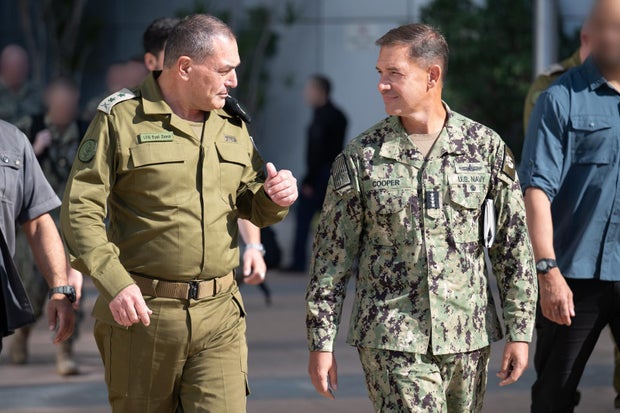
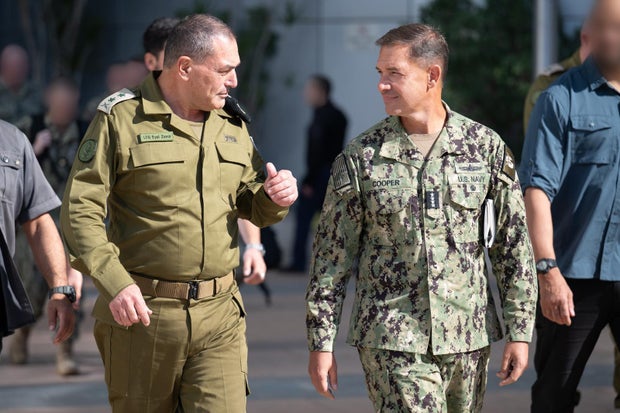
The chief of Israel’s military, Lt. Gen. Eyal Zamir, met with U.S. Central Command leader Adm. Brad Cooper in Tel Aviv on Wednesday to discuss the current situation in the Middle East.
“During the meeting, the participants discussed regional developments and shared security challenges,” Israeli officials said in a statement. “They also addressed the importance of deepening strategic and operational cooperation between the two militaries, strengthening coordination, and enhancing joint readiness to address a range of scenarios.”
CENTCOM oversees military action in the Middle East and Cooper has become an important member of the Trump administration’s Defense Department.
Israel Defense Forces
In addition, Zamir, Cooper and Mossad Director Roman Gofman took part in a trilateral meeting. Mossad is Israel’s foreign intelligence agency, similar to the U.S. Central Intelligence Agency.
The U.S. and Israel have been debating whether to restart larger military action against Iran in the past several weeks after talks prior to Election Day fell apart. The U.S. launched a strike on Qeshm Island on Tuesday, which was categorized as self-defense after Iran had launched unsuccessful strikes against Bahrain multiple times this week.
By Mark Osborne
Explosion heard in Saudi capital, missiles intercepted
A powerful explosion rattled homes in Riyadh on Wednesday, AFP journalists and residents said, as Yemen’s Iran-backed Houthis pressed their campaign of attacks against Saudi Arabia.
The Saudi-led coalition fighting the Houthis also said they intercepted two cruise missiles — the latest in weeks of strikes targeting military, civilian and oil infrastructure.
Later on Wednesday, the coalition said it had intercepted two drones launched by the Houthis in the Riyadh and southern regions, after Saudi authorities had issued and later lifted an alert for the southern Sharurah governorate.
Residents said Wednesday’s explosion came without warning, with no cellphone alert issued beforehand as is usually the case during aerial threats.
“The explosion was extremely loud,” said a resident in northern Riyadh. “Hearing a blast without receiving a warning is very frightening.”
An AFP journalist said doors throughout her home swung open and the lights briefly went out.
The location of the explosion was not immediately clear, but residents told AFP they saw smoke near Riyadh’s airport in the northeast of the city.
By AFP
U.S. intelligence chief says Iranian threats inside and outside U.S. have “dramatically increased”
U.S. Director of National Intelligence Jay Clayton said Wednesday that Iranian threats inside and outside the U.S. have “dramatically increased.”
“We remain committed to detecting, deterring and combatting the Iranian lethal plotting outside the United States and inside the United States,” Clayton told members of the House Homeland Security Committee during a hearing. “These threats have dramatically increased.”
He emphasized the danger posed by online radicalization, describing how foreign extremist networks can influence individuals already living inside the United States.
“That’s not theoretical; it’s real,” Clayton said.
Deputy FBI Director Christopher Raia noted that intelligence about possible plots does not necessarily mean would-be attackers have the capability to carry out the plans.
“A lot of the reporting is largely aspirational,” Raia said. “But that does not mean we do not take it seriously.”
Read more here.
By Nicole Sganga, Kaia Hubbard
Saudi Arabia preparing for Yemen war to continue into 2027, Western officials tell Reuters
Saudi Arabia is preparing for its war against the Iran-backed Houthis in Yemen to last well into 2027, the Reuters news agency reported Wednesday, citing two Western officials briefed by the kingdom about its planning.
Fighting in Yemen’s grueling civil war between the Houthi rebels and Yemen’s Saudi-backed government had largely stopped after a ceasefire was signed in 2022, but reignited over the summer as the war launched by the U.S. and Israel against Iran sent tension across the Middle East surging.
The exchange of fire between the Houthis and Saudi Arabia has been more intense than the other fronts in the intertwined Middle Eastern conflicts since U.S.-Iran hostilities eased late in the summer. Thousands of people have been killed and hundreds of thousands displaced in Yemen, and Houthi rockets have killed at least 20 people in Saudi Arabia.
Saudi authorities have acknowledged Houthi targeting of key infrastructure in the kingdom, including airports and oil facilities. The kingdom now expects the campaign to last up to six more months, Reuters said, adding that Saudi officials are hoping to see advances on the ground before re-entering negotiations with the Houthis.
This week, however, has seen Yemeni government-aligned forces pull back from some key territory on the Red Sea coast as the Houthis take more ground.
By Frank Andrews
U.S. military shares images of 2 aircraft carriers together in Middle East
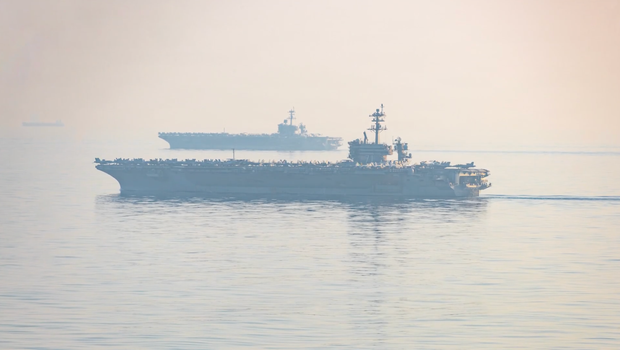
The U.S. military’s Central Command shared new images Wednesday of the USS Theodore Roosevelt and USS George Washington aircraft carriers sailing in tandem in the Arabian Sea.
CENTCOM included a photo compilation of the two nuclear-powered carriers in a post on X that offered no information, just a date and the vague location of the carrier in the sea, which is southeast of the Strait of Hormuz and Persian Gulf beyond.
U.S. Central Command/X
The U.S. military’s naval presence in the Gulf of Oman, the Arabian Sea, Red Sea, and Mediterranean is currently greater than the force deployed during Operation Epic Fury, at the peak of U.S. and Iranian hostilities, according to an open source intelligence analysis by the independent Israeli think tank The Institute for National Security Studies.
The U.S. military confirmed Monday that there are now three aircraft carrier strike groups in the region after the recent arrival of the USS Roosevelt. It joined the USS George H.W. Bush and USS Washington, alongside a slew of associated destroyers and other vessels.
The three-carrier presence is expected to be temporary, as carrier strike groups rotate through the region.
By Frank Andrews
Iran denies any link to alleged “terrorist plot” in North Macedonia
Iran on Wednesday rejected as “completely unfounded” an assertion by authorities in North Macedonia that they had uncovered a Tehran-backed assassination plot targeting a person in Greece.
The Iranian Embassy in Greece called the “baseless accusations” part of a “worn-out campaign by the Israeli regime and its propaganda and psychological warfare apparatuses to discredit Iran.”
North Macedonia’s National Security Agency said Tuesday that it had foiled an alleged plot and dismantled a network linked to Iran in cooperation with Greek intelligence.
Four suspects are in custody and a fifth under house arrest in North Macedonia, the authorities said.
Some Greek media, including the ERT state broadcaster and the daily Kathimerini, reported that the target was allegedly an Israeli-born executive of an Israeli company based in Greece.
According to North Macedonia’s security agency, the dismantled network included “proxy actors” linked to Iranian national Edris Jahangiri Mavaneh, who was a “collaborator of the Iranian security and intelligence services.”
The network, “under the direct instructions of the Iranian national, undertook preparatory logistical activities to carry out a terrorist act/assassination against a person in Greece,” the agency said.
CBS/AFP
U.S.-Saudi nuclear agreement “very satisfactory,” says U.N. nuclear watchdog agency IAEA
The head of the IAEA, the United Nations nuclear watchdog agency, described on Wednesday a deal that could see the United States help equip Saudi Arabia with a civilian nuclear program as “very satisfactory.”
The deal announced in July has drawn questions about the risks of possible nuclear proliferation.
“It’s a very satisfactory outcome that we have with this agreement,” Grossi told reporters after opening an International Atomic Energy Agency board of governors’ meeting, according to the AFP news agency.
The IAEA chief said if and when nuclear power development gets under way in Saudi Arabia, “we will be there.”
In his opening statement, Grossi told the board the U.S. and Saudi Arabia had asked the IAEA in October “to take the necessary steps to implement safeguards and verification measures” for their agreement.
Under the deal, the IAEA “will be provided with information about, and access to any sites for conversion, enrichment, fuel fabrication and reprocessing” in Saudi Arabia, Grossi said, adding that he welcomed “the open, transparent approach and engagement of both governments with member states and the secretariat on this matter.”
Saudi Arabia had also agreed to “additional verification measures on a voluntary basis,” Grossi said.
President Trump said after the agreement was signed that moving forward on the deal would be contingent upon Saudi Arabia signing onto the Abraham Accords, formally normalizing relations with Israel.
CBS/AFP
By Frank Andrews
U.S. naval presence in Mideast now greater than during peak of war with Iran, think tank says
The U.S. military’s naval presence in the Gulf of Oman, the Arabian Sea, Red Sea, and Mediterranean is currently greater than the force that was deployed during Operation Epic Fury, at the peak of U.S. and Iranian hostilities, according to an open source intelligence analysis by the Institute for National Security Studies, an independent think tank in Israel.
The U.S. military confirmed Monday that there are now three aircraft carrier strike groups in the region after the recent arrival of the USS Theodore Roosevelt. That carrier joined the USS George H.W. Bush and USS George Washington, alongside with a slew of destroyers and other vessels.
The three-carrier presence is expected to be temporary, however, as carrier strike groups rotate through the region.
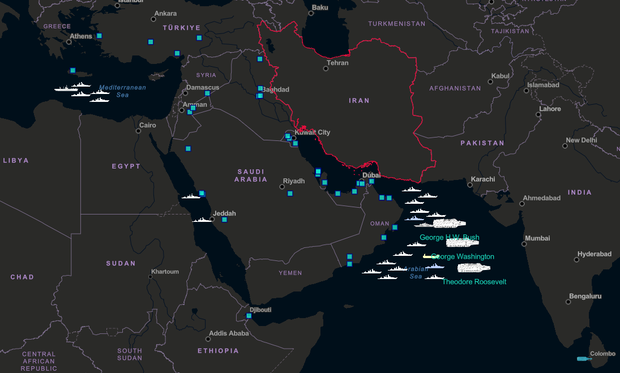
According to an interactive map published by the INSS, the U.S. has deployed 12 destroyers to the Arabian Sea, one of which appears to be positioned just inside the Gulf of Oman, east of the Strait of Hormuz.
The map indicates that there are not currently any U.S. warships in the Persian Gulf or the gateway to it, the Strait of Hormuz, which Iran and the U.S. both claim control over.
A senior Iranian military figure said in late October that the regime “will not allow U.S. military ships in the Persian Gulf under any circumstances and at any time.”
“The U.S. president must dream of seeing the armed forces enter the Persian Gulf,” Iranian armed forces chief of staff Ali Abdollahi was quoted as saying by state TV. “He will take that dream to his grave.”
The INSS map does show two U.S destroyers in the Red Sea, where the Iran-backed Houthi rebels have recently expanded their control over Yemen’s coastline on the Bab el-Mandeb Strait, threatening Saudi Arabia’s oil exports.
Institute for National Security Studies
Iranian protesters criticize regime in rare public demonstration after deadly bus crash
Some demonstrators who gathered in western Iranian town offered rare public criticism of the Islamic Republic regime Tuesday during a protest over the deaths of 13 gas and oil workers in a bus crash, according to eyewitness accounts.
While Iran’s tightly controlled media outlets portrayed the gathering in the city of Abdanan as a protest over road safety, eyewitnesses said the demonstration took on an anti-government tone.
Iran’s Fars News Agency, which is closely affiliated with the country’s powerful Islamic Revolutionary Guard Corps, reported that the protest grew to around 1,000 people, and it acknowledged that slogans chanted by attendees had a “political tone.”
“At first, people were mostly angry about the accident, but gradually the slogans became political and against the government,” Jamshid, a shopkeeper who witnessed the demonstration, told CBS News over the phone.
He said “security forces eventually dispersed the crowd by force, using tear gas and even shooting warning shots.”
State broadcaster IRIB called the gathering “another failure of the counter-revolution plan” and claimed residents had come out to quell the unrest themselves in support of the government.
A resident of Iran’s capital Tehran, who asked to remain anonymous due to concerns for his safety, disputed the state broadcaster’s account.
“The accident brought people into the streets, but the anger wasn’t only about the workers who died,” he told CBS News. “People were chanting against the government, even against the new supreme leader, and some were supporting the exiled crowned prince.”
By Seyed Rahim Bathaei
Saudi coalition says major attack on Iran’s Houthi allies in Yemen destroyed “60 legitimate military targets”
The Saudi-led coalition fighting the Iranian-backed Houthis said Wednesday it launched a major air attack across territory held by the rebels in Yemen. The Houthis said the Saudi strikes killed at least 17 people.
Maj. Gen. Turki al-Maliki, spokesman for the Saudi coalition, said the strikes launched Tuesday destroyed “60 legitimate military targets” in Yemen’s Houthi-held capital Sanaa, and the provinces of Amran, Saada and Hodeida.
The strikes aimed to weaken the Houthis’ missile and drone capabilities by destroying tunnels into mountain warehouses where ballistic missiles are stored, and workshops used to assemble and store drones, al-Maliki said.
Anees al-Asbahi, a spokesman for the Houthi-run health ministry, said one strike hit a sponge factory in Hodeida, killing at least 15 people and wounding 13 others. Another strike in the district of Kitaf in Saada killed at least two people and wounded four others. In Sanaa, at least nine people were wounded in a strike that hit a shoe factory, al-Asbahi said.
CBS/AP
Bahrain, Kuwait say they fended off strikes by Iran
Bahrain and Kuwait claimed Wednesday that they repelled air attacks launched against them, as Gulf nations face retaliatory bombardment following U.S. strikes on an Iranian island.The Iranian army said Wednesday its drones “targeted Patriot air defence systems and drone and missile launch platforms belonging to the terrorist U.S. military at Ali Al-Salem Air Base in Kuwait,” in a statement carried by state television IRIB.
Kuwait’s military said Wednesday its air defenses were “responding to hostile drone threats” and urged the public to follow security and safety advice.
The foreign ministry said in a statement posted on social media that “the continuation of these attacks constitutes a dangerous escalation that threatens the region’s security and stability and undermines diplomatic efforts aimed at de-escalation.”
Meanwhile, Bahrain said its air defenses intercepted attacks early Wednesday, a day after Tehran’s Revolutionary Guard said it struck a base used by the U.S.
Iran’s official IRNA news agency cited a regional official as saying the United States had hit Qeshm Island in the Strait of Hormuz but did not cause serious damage.
CBS/AFP
Iraq resumes pumping oil through pipeline to Turkey in order to avoid Strait of Hormuz
Iraq has resumed pumping oil to Turkey through a pipeline at an initial capacity of 120,000 barrels a day, Oil Minister Bassem Mohammed Khudair al-Abadi said Tuesday in comments carried by state media. The export capacity will be gradually increased to reach 500,000 barrels a day, he said.
The capacity is fairly small compared to other pipelines in the region. The Saudi East-West pipeline, which crosses from the Persian Gulf to the Red Sea in order to avoid the Strait of Hormuz and Bab el-Mandeb Strait, has a capacity of 7 million barrels per day.
In August, Iraq and Turkey signed a deal to increase oil exports through a pipeline to the Turkish Mediterranean port of Ceyhan.
Iraq is moving to strengthen the resilience of its oil export infrastructure following the U.S.-Iran war’s disruptions to shipping through the Strait of Hormuz.
The Iraq-Turkey pipeline has been largely idle since 2023 following legal and commercial disputes.
CBS/AP
One crew member missing after ship struck in Strait of Hormuz, UAE state oil firm says
The United Arab Emirates’ oil firm ADNOC said Wednesday that a crew member was missing after one of its ships was struck the night before in the Strait of Hormuz.
“All other crew members have been safely evacuated from the vessel. Eleven sustained injuries and where required are receiving medical care,” ADNOC said, adding that search and rescue operations were continuing.
Monitoring agencies report ships being attacked in or near the Strait of Hormuz on a near-daily basis. Iran claims it carried out some of the attacks on ships it considers transiting through the waterway without its permission.
The U.S. military has also previously said it struck and halted ships it deems to be violating its naval blockade on Iranian ports.
CBS/AFP
U.S. announces “self-defense” strikes on Iran’s Qeshm Island
The U.S. launched precision strikes on an Islamic Revolutionary Guard Corps missile site on Iran’s Qeshm Island in the Strait of Hormuz, according to a U.S. military official.
The official said the strike was launched “in self-defense.”
“The strike was in response to IRGC aggression targeting U.S. personnel and assets,” the official said. “U.S. Central Command remains highly vigilant and fully postured to protect Americans across the region.”
While the official did not specifically mention the IRGC aggression, the strikes came hours after Iran targeted a U.S. radar site in Bahrain. The s
This was the third attempted strike by Iran on a U.S. military installation in the last five days. All of them were intercepted, U.S. officials said.trikes were successfully intercepted, according to U.S. Central Command.
Iran had earlier said the U.S. attacked Qeshm Island, but they “caused no damage to residential, commercial, or infrastructural areas,” according to Ahmad Nafisi, deputy provincial governor of the southern province of Hormozgan, quoted by the official IRNA news agency.
By Mark Osborne, Charlie D’Agata