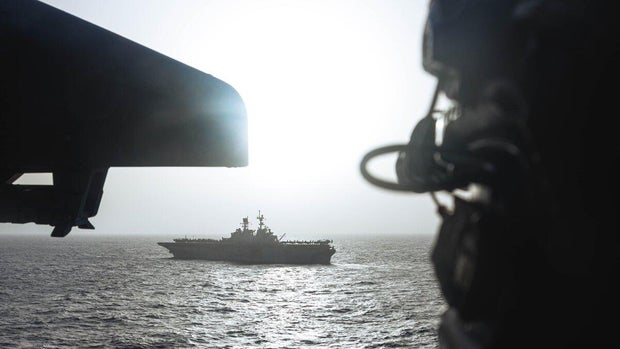
Iraq condemns attacks allegedly launched from within country on UAE, Saudi Arabia
Iraq’s prime minister condemned alleged attacks launched from within its borders on Saudi Arabia and the United Arab Emirates.
The UAE said on Tuesday a drone that hit a nuclear plant was launched from within Iraq, while the Saudis said they intercepted three drones entering their airspace from Iraq.
Iraqi Prime Minister Ali Faleh Al-Zaidi said Thursday the country was renewing its “condemnation and renunciation” of the attacks and pledged a joint investigation of both strikes with the UAE and Saudi Arabia.
“We express our rejection of the use of Iraqi territory or airspace as a launching ground for attacks against brotherly and friendly states, and reaffirm Iraq’s role as a meeting point for shared interests,” Al-Zaidi said on X.
There are several Iran-backed militias operating in Iraqi territory separate from the Iraqi government.
By Mark Osborne
Iranian official argues restrictions in Strait of Hormuz necessitated by “fundamental change of circumstances”
Iranian Deputy Foreign Minister Kazem Gharibabadi argued in an article published Thursday that shipping in the Strait of Hormuz has fundamentally changed due to what he calls the repeated acts of aggression and destabilizing actions of the United States and Israel.
In his article in the Iran Daily outlet, Gharibabadi contends the days of free and open shipping through the vital shipping channel were based on “comity and mutual good faith,” but that the war launched by the U.S. and Israel on Feb. 28 had brought a “fundamental change of circumstances.”
The new circumstances, he said, have made it necessary for Iran to impose “an adjustment of rights and obligations,” referring to Iran’s current demand for all ships to seek permission from its military — and sometimes to pay a fee — for passage.
He said international law do not guarantee unrestricted passage of a waterway when the security of a coastal state is threatened, and cites legal principles, including the United Nations founding charter and the U.N. Convention on the Law of the Sea, to argue a case for coastal state sovereignty over territorial waters.
By Tucker Reals
Trump wants travel through Strait of Hormuz to be free of tolls, he says
President Trump said Thursday the U.S. does not want to collect tolls on the Strait of Hormuz after some back-and-forth on the issue since the war began.
“We want it open, we want it free. We don’t want tolls,” Mr. Trump said. “It’s an international waterway.”
Last month, the president said he would like to see the U.S. collect tolls, but following a summit with Chinese President Xi Jinping, the two sides had agreed “no country or organization can be allowed to charge tolls.”
Mr. Trump said outright on Thursday that Iran is “not charging tolls right now,” even though Iran said its newly formed Persian Gulf Strait Authority has begun collecting tolls.
“They’re not charging tolls right now,” Trump said Thursday. “They are losing $500 million a day, is what it’s projected. That sounds like a lot of money, but whether it’s 500 or 200 or 300 they’re losing a lot of money.”
Iran has not said how much money it has collected for tolls.
“There hasn’t been a ship that’s been able to get through without our approval,” the president said.
The U.S. has redirected 94 commercial vessels heading either into or out of Iranian ports since the blockade began on the Strait of Hormuz, U.S. Central Command said Thursday.
By Mark Osborne
Trump repeats Iran cannot get nuclear weapon, calls country “somewhat crazy”
President Trump repeated the familiar conditions for peace that Iran should not be allowed to develop a nuclear weapon when asked Thursday during an unrelated press conference with EPA Administrator Lee Zeldin.
“Right now, we’re negotiating and we’ll see, but either we’re going to get it one way or the other,” Trump said, referring to whether a deal can be negotiated or bombing would resume. “They’re not gonna have a nuclear weapon, you know?”
Trump said if the question was put to Americans, “they will all agree” Iran cannot get a nuclear weapon.
“This is the nuclearization of a country that some people would say is somewhat crazy, and we cannot let Iran have a nuclear weapon, that’s all it is,” he said. “We can’t let it.”
“You will have a nuclear war in the Middle East, and that war will come here, that war will go to Europe,” Mr. Trump said. “We cannot let that happen, and it won’t happen. That’s more important than anything else.”
By Mark Osborne
NATO allies “refuse to do anything” to support U.S.-Israeli war with Iran, Rubio says
Secretary of State Marco Rubio on Thursday renewed criticism of America’s NATO allies for not supporting the U.S.-Israeli war with Iran, as he headed for a meeting of the alliance in Sweden.
President Trump is “not asking them to send their fighter jets in. But they refuse to do anything,” Rubio told reporters. “We were very upset about that.”
Last week, amid sharp criticism from Mr. Trump of all NATO partners for declining to join offensive operations against Iran, France said it was sending an aircraft carrier to the region for an “upcoming multinational initiative to secure the Strait of Hormuz.”
France and the U.K. have led efforts to build a coalition of nations willing to help ensure the Strait of Hormuz remains safe and passable, but only after hostilities are over.
CBS/AFP
By Mark Osborne
U.N. rights chief “deplores the execution of two more people in Iran”
The United Nations human rights chief “deplores the execution of two more people in Iran,” his office said in a statement Thursday, accusing Tehran of using the war with the U.S. and Israel as grounds to further stifle domestic dissent.
“Since the military escalation began, at least 34 people have been executed on political and national security charges, including in the context of the January protests. It is unacceptable that the Iranian authorities are instrumentalising the current conflict to further stifle dissent,” United Nations High Commissioner for Human Rights Volker Turk’s office said.
The number of executions carried out by Iran doubled last year, according to a report by Amnesty International, with at least 2,159 people being put to death by the country’s powerful Judiciary authority.
CBS/AFP
Germany charges two accused of Iran-backed murder plot
German prosecutors charged two men Thursday with planning to kill a prominent pro-Israel public figure and spying on Jews on behalf of Iranian secret services.
Danish national Ali S. is charged with espionage, attempted murder, attempted arson and sabotage, prosecutors in Karlsruhe said. His alleged Afghan accomplice Tawab M. is accused of attempted murder.
The two men were remanded in custody in Germany following their arrest last year in Denmark and subsequent extradition.
Ali S. allegedly spied on the head of the German-Israeli Society, the former Greens Member of Parliament Volker Beck, as part of plans to assassinate him, prosecutors said.
The suspect is further said to have spied on the president of the Central Council of Jews in Germany, Josef Schuster, as well as two Jewish grocers in Berlin as part of plans to carry out arson attacks, prosecutors added.
Prosecutors say Ali S. in early 2025 took orders from the Quds Force, the foreign operations branch of Iran’s Islamic Revolutionary Guard Corps.
They allege he made contact by May last year with Tawab M., who said he was ready to supply weapons to a third party in an attempt to kill Beck.
By Frank Andrews
Rubio hopes Pakistani talks with Iran will advance peace deal
Secretary of State Marco Rubio voiced hope Thursday that a visit by Pakistan’s army chief to Iran would advance diplomatic efforts to broker an end of the country’s war with the U.S.
“I believe the Pakistanis will be traveling to Tehran today. So hopefully that’ll advance this further,” Rubio told reporters.
One of Pakistan’s top mediators in the ongoing negotiations between the U.S. and Iran, Army Chief Asim Munir, was expected in Tehran Thursday as part of Islamabad’s efforts to broker a peace deal, according to Iranian news outlets.
CBS/AFP
U.S. military has “redirected” 90 ships under blockade, CENTCOM says
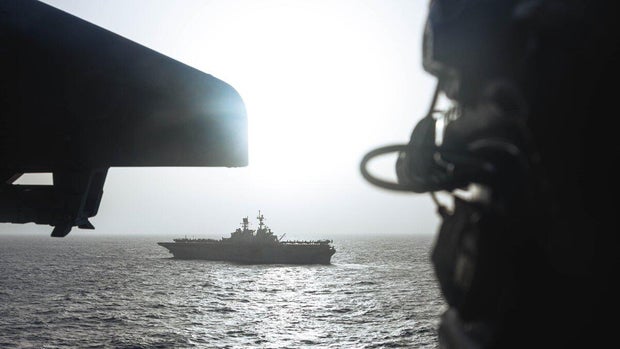
The U.S. military has redirected 94 ships under its blockade of Iranian ports and vessels, Central Command said Thursday in a post on X.
U.S. forces have “disabled” another four vessels “to prevent the flow of commerce into and out of Iranian ports,” it said.
CENTCOM
The U.S. imposed its blockade on Iranian ports in early April.
Iran considers the blockade a violation of the two countries’ ceasefire agreement and has been enforcing a de facto blockade of its own on all ships transiting on the Strait of Hormuz, demanding they do so only in coordination with its military, and often charging steep fees for passage.
By Frank Andrews
Italy requests EU sanctions against far-right Israeli minister over treatment of Gaza flotilla activists
Italy has asked the European Union to adopt sanctions against an Israeli government minister after video emerged of him mocking pro-Palestinian flotilla activists.
On Wednesday, Israel’s minister of national security Itamar Ben-Gvir posted video of himself mocking activists who had been detained in international waters during an attempt to breach the Israeli naval blockade of the Gaza Strip.
Israeli armed forces intercepted all of the Global Sumud Flotilla’s boats this week in different parts of the Mediterranean.
In the clips, Ben-Gvir is seen walking among some of the approximately 430 detained activists flanked by police and soldiers. He is seen waving a large Israeli flag and telling some of the activists, “Welcome to Israel, we are the landlords.”
In another video, he says the activists “came here all full of pride like big heroes. Look at them now.”
In a post on X, Italian Foreign Minister Antonio Tajani wrote Thursday that, on behalf of the Italian government, he had requested the adoption of sanctions against Ben-Gvir when the EU foreign ministers next convene, “for the unacceptable acts committed against the Flotilla, seizing the activists in international waters and subjecting them to harassment and humiliation, in violation of the most basic human rights.”
Ben-Gvir has already been sanctioned by Australia, Canada, New Zealand, Norway and the United Kingdom for inciting violence against Palestinians.
All the activists from the flotilla have been deported from Israel, a foreign ministry spokesperson said Thursday.
By Frank Andrews
Iranian president vows to continue strengthening the country’s military
Iranian president Masoud Pezeshkian vowed Thursday to use all available resources to strengthen the country’s military, according to a statement published by his office.
Pezeshkian made the promise during a meeting with the head of Iran’s Army, Maj. Gen. Amir Hatami, according to the statement.
“The government stands with the armed forces with all its capacity and will support strategic plans to enhance defense capabilities, logistical support, equipment modernization, strengthening operational infrastructure, and increasing the country’s deterrence capability,” it said.
Hatami told Pezeshkian the Iranian Army was “fully prepared to provide a decisive, regrettable response” to any new attack on Iran, the president’s office said.
By Frank Andrews, Khaled Wassef
US stocks slip in early trading as oil prices turn upward again
U.S. stocks slipped in early trading Thursday after oil prices rebounded and cranked up the pressure from the bond market.
The S&P 500 fell 0.4% early Thursday and is on track for a fourth drop in five days.
The Dow Jones Industrial Average fell 160 points, and the Nasdaq composite fell 0.5%.
International benchmark Brent crude oil rose 3% Thursday to trade at about $108 per barrel after turning downward earlier in the week.
Oil prices have fluctuated dramatically for almost three months amid uncertainty over how long the Iran war will keep tanker traffic through the Strait of Hormuz severely limited, but they have remained significantly higher since the war began.
CBS/AP
Iranian sources tell Reuters new supreme leader has barred removal of enriched uranium
Iranian Supreme Leader Mojtaba Khamenei has formally declared that the country’s highly enriched uranium stockpile must remain within the country, according to the Reuters news agency, which cited two senior Iranian sources.
Iran is believed to have close to 900 pounds of uranium enriched to 60% purity, a short technological step to the 90% enrichment required for a nuclear weapon. That uranium is believed to be buried under one of the Iranian nuclear facilities badly damaged by U.S. and Israeli airstrikes in June 2025.
Khamenei has not been seen or heard from publicly since he was announced as his father’s successor early in the war, but several statements attributed to him have been relayed by state media.
If he has decreed, as the Reuters sources contend, that the uranium must remain in the country, it would amount to a flat rejection of one of the main U.S. demands in the ongoing negotiations between the two countries toward a peace deal.
President Trump has insisted the war was necessary to ensure Iran cannot build a nuclear weapon, and he’s claimed on various occasions that Tehran agreed to hand it over in coordination with the U.S., and that American forces could just take it by force.
CBS News has not been able to independently confirm the Reuters report, and a reporter with Qatari state-backed network Al Jazeera cited a senior Iranian official later Thursday as denying the Reuters report, calling it “propaganda by the enemies of the deal.”
“No new order has been issued,” Al Jazeera’s reporter said, citing the source, whom he said called the nuclear material “the subject of talks in the next stage.”
By Frank Andrews
War could quash Iran’s movie industry, warn directors at Cannes film festival
Independent filmmakers in Iran face a fresh wave of repression and extreme economic hardship because of the war, risking choking off a mainstay of world cinema, top directors tell the AFP news agency.
Pegah Ahangarani, an actor-director who fled the country in 2022, is one of several Iranian filmmakers at the Cannes Film Festival, which has championed Iranian cinema for decades and awarded its top prize to Panahi last year.
“In recent years, there’s really been a massive underground, clandestine film movement, a lot of filmmakers have started making films without authorization, without women in headscarves,” the 42-year-old told AFP in Cannes.
“Now, with the war, the little information we get from Iran tends to show that it’s the same for filmmakers as for the rest of the population, meaning repression that is stronger than ever. They are much harsher than before,” she said.
Iran has carried out mass arrests and a spate of executions since the U.S.-Israeli attack on the country on Feb. 28 which also prompted authorities to block access to the international internet for most people.
Kaveh Farnam, a Dubai-based director and former head of the Iranian Independent Filmmakers Association, said inflation and internet censorship are had a devastating effect on all the technical staff who work in the Iranian cinema industry.
“I know many industry people who haven’t been able to work for months,” he told AFP. “They are badly under pressure, out of money, with no income and the prices are increasing every day.”
The war has given “an excuse for the regime to be more savage and brutal,” he said.
By AFP
30 more ships transit Strait of Hormuz after coordinating with the Iranian navy, Iran state TV claims
Roughly 30 more vessels were transiting the Strait of Hormuz Thursday in coordination with Iran’s naval forces, Iranian state TV says.
The ships all began traveling through the vital shipping lane Wednesday and they were expected to complete their transits by Thursday evening local time, according to the report.
The owners and captains of the ships were said to be in contact with the naval forces of Iran’s Islamic Revolutionary Guard Corps, which was ensuring the vessels stuck to routes designated by the IRGC. Those routes pass very close to an island in the far north of the strait, near Iran’s coast, which the regime is believed to be using as a de facto toll booth to collect fees for passage.
While the U.S. has enforced a blockade of Iranian ports and vessels, Iran has said it will attack any ship that attempts to transit the strait without coordinating with its military.
The ownership of the vessels Iran claims are moving through the waterway on Thursday was not clear, and if they are Iranian owned or carrying Iranian energy products, they may be targeted for interception or seizure by U.S. forces as part of the American blockade.
Several oil tankers have passed through the waterway in recent days, according to Iran. South Korea confirmed that one of its tankers transited the strait this week, in coordination with Iranian authorities.
By Frank Andrews
U.K. summons top Israeli envoy in London over video of security minister taunting flotilla activists
The U.K. government on Thursday joined a growing number of countries condemning Israel’s far-right national security minister over a video showing him involved in degrading treatment of pro-Palestinian flotilla activists in the custody of Israeli forces.
In a statement, the British government said it was summoning Israel’s chargé d’affaires “following the inflammatory video” that emerged of Itamar Ben-Gvir mocking the activists.
Ben-Gvir, a government minister who has been sanctioned by U.S. allies for inciting violence against Palestinians, is seen in one clip that he posted on social media walking among some of the approximately 430 detained Sumud Global Flotilla activists with police and soldiers.
He can be seen waving a large Israeli flag and telling some of the activists, “Welcome to Israel, we are the landlords.”
In another video, Ben-Gvir says the activists “came here all full of pride like big heroes. Look at them now.”
The British government said his behavior “violates the most basic standards of respect and dignity for people,” and added that it was “deeply concerned by the detention conditions depicted and have demanded an explanation from the Israeli authorities.”
The U.K. joins the European Union, Italy, Poland, France, Canada and multiple other countries in condemning the actions of Ben-Gvir and the treatment of the detained activists. Several countries have summoned the Israeli ambassadors in their capitals, and Spain’s government has said it will push for an existing ban on Ben-Gvir entering the country to be extended across the European Union.
Israeli Prime Minister Benjamin Netanyahu defended the detention of the activists on Wednesday, but he rebuked Ben-Gvir, saying the cabinet member’s behavior was “not in line with Israel’s values and norms.”
U.S. Ambassador to Israel Mike Huckabee said Ben-Gvir had “betrayed the dignity” of Israel in his treatment of the detainees.
Israel began deporting some of the hundreds of detained activists on Thursday.
By Frank Andrews
Iran’s U.N. envoy accuses Security Council of failing in its duties amid Trump’s threats
Iran’s permanent representative to the United Nations, Amir Saeid Iravani, accused the Security Council of failing to “discharge its responsibilities” in the face of repeated threats from President Trump.
The council “must not remain silent or indifferent to the repeated and daily basis threats made by the President of the United States against Iran, including explicit threats to bomb Iran ‘back to the Stone Age,'” said Iravani.
The Security Council has “failed to discharge its responsibilities in the face of these grave violations,” he said, adding that “the normalization of such threats of force … by a permanent member of the Security Council sets a dangerous precedent.”
The U.S. is one of five permanent members of the council, giving it veto power to block binding resolutions in the body, regardless of how the other 20 member states vote.
Mr. Trump said Tuesday that he had been just “an hour away” from deciding whether to order new strikes on Iran the previous night. On Wednesday, he said was willing to wait “a couple of days” for Iran’s response to the latest U.S. peace proposal.
By Frank Andrews, Khaled Wassef
20 Iranian sailors whose ship was seized by the U.S. near Singapore returned to Iran, say Iranian media
Twenty Iranian sailors whose ship was seized by U.S. forces near Singapore have returned to Iran, according to Iranian state media.
Iran’s ambassador to Pakistan, Reza Amiri Moghadam, said Thursday that the release of the 20 Iranian sailors was thanks to the “benevolent action of the esteemed government of Pakistan.”
In a post on X, he described the sailors’ situation as “precarious due to the seizure of their ship.”
Iran’s IRNA news agency reported that their vessel was seized by U.S. forces, but neither Iran nor Pakistan have named the ship.
In a social media post last week, Pakistan’s Foreign Minister Ishaq Dar referred to 20 Iranian sailors and 11 Pakistanis returning home via Singapore, “who were aboard vessels seized in the high seas by the United States.”
The U.S. has, since early April, enforced a military blockade of Iranian ports and associated vessels, and it has seized several ships as part of that mission.
Iran, meanwhile, has enforced its own de facto blockade of the Strait of Hormuz, demanding any ship wishing to transit the vital waterway do so in coordination with its military – often for a hefty fee.
In recent days, several oil tankers have passed through the contested waterway in coordination with the Iranian navy, according to Iran. South Korea confirmed that one of its tankers did transit the strait this week, in coordination with Iranian authorities.
By Frank Andrews
Pakistani prime minister to visit China May 23-26, says Beijing
Pakistan Prime Minister Shehbaz Sharif will visit Beijing from Saturday to Tuesday for talks, the Chinese foreign ministry said Thursday, without specifying whether the war in Iran would be discussed.
“The leaders of China and Pakistan will have an in-depth exchange of views on bilateral relations and issues of common concern,” ministry spokesman Guo Jiakun told a press conference on Thursday, adding that “China supports Pakistan in playing a fair and balanced mediating role in promoting peace and ending the war.”
The two countries have both sought to mediate in the Middle East conflict, which was sparked by U.S. and Israeli strikes.
One of Pakistan’s top mediators in the ongoing negotiations between the U.S. and Iran, Army Chief Asim Munir, is due to arrive in Tehran Thursday in an effort to broker a peace deal, according to Iranian news outlets.
By AFP
UAE official slams Iran’s Hormuz control plan as “pipe dream”
A top UAE official denounced Iran’s claim of control over Emirati waters in the blockaded Strait of Hormuz as a “pipe dream” Thursday, following an announcement by an Iranian body overseeing the strait.
“The regime is trying to establish a new reality born from a clear military defeat, but attempts to control the Strait of Hormuz or infringe on the UAE’s maritime sovereignty are nothing but pipe dreams,” said the United Arab Emirates’ presidential advisor Anwar Gargash in a post on X.
By AFP
Israel begins deporting hundreds of flotilla activists
Israel has released hundreds of activists who attempted to breach Israel’s naval blockade of Gaza and are in the process of deporting them, according to a legal organization working with the flotilla.
The Israel-based legal advocacy group, the Legal Center for Arab Minority Rights in Israel, or Adalah, said Thursday that most of the international activists were in transit to a civilian airport near the southern Israeli city of Eilat for deportation.
Prime Minister Benjamin Netanyahu said on Wednesday he instructed that the activists be deported “as soon as possible,” after sharply rebuking Israel’s national security minister for a provocative video showing the minister taunting detained flotilla activists who were handcuffed and kneeling.
Netanyahu said that although Israel has every right to stop “provocative flotillas of Hamas terrorist supporters,” the way National Security Minister Itamar Ben-Gvir dealt with the activists was “not in line with Israel’s values and norms.”
Ben-Gvir released videos Wednesday showing him walking among some of the approximately 430 detainees. In one, activists with their hands tied behind their backs are kneeling, their heads touching the floor inside what appears to be a makeshift detention area on the deck of a ship.
The flotilla, made up of more than 50 boats, departed for Gaza last week from Turkey, near Cyprus. Organizers said they want to draw renewed attention to the living conditions of the nearly 2 million Palestinians in the Gaza Strip.
By The Associated Press
Iran looking over latest U.S. peace proposals, state media say
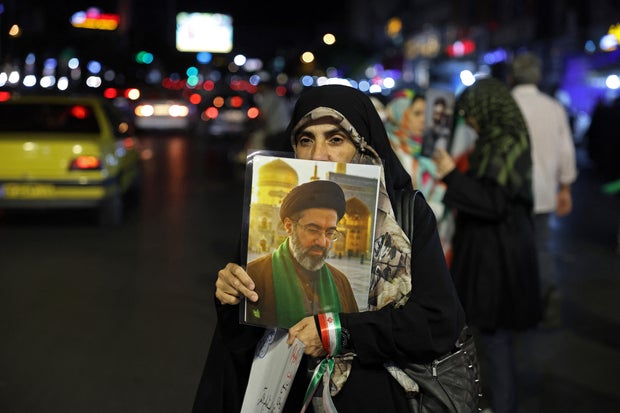
Iran’s government is reviewing the latest proposal for a peace deal from the United States, with Pakistani army chief Asim Munir, expected in Tehran Thursday to continue efforts to mediate between the two countries.
“We have received the views of the American side and are currently reviewing them,” Nour News, which is close to Iran’s Supreme National Security Council, quoted Foreign Ministry spokesman Esmaeil Baqaei as saying Thursday.
–
Baqaei added that the current Pakistan-mediated exchanges between the U.S. and Iran were based on Iran’s initial 14-point framework proposal, which called for “a definitive end to the war on all fronts, including Lebanon,” the release of frozen Iranian financial assets and an end to what he described as “piracy” against Iranian commercial vessels.
Iranian lawmaker Fada Hossein Maleki said in remarks aired on state TV that the Pakistani Army chief would arrive in Tehran carrying a new message from the U.S.
By Khaled Wassef
Pakistan army chief heading to Tehran to continue mediation efforts, Iranian state media say
Pakistan’s Army Chief Asim Munir will travel to Tehran on Thursday to continue his nation’s efforts to broker a deal to end the U.S.-Israeli war with Iran, Iran’s ISNA news agency said.
“The visit comes amid continued regional diplomatic activity aimed at easing tensions and advancing negotiations,” ISNA said.
Pakistan has been the leading mediator between the U.S. and Iran, conveying messages as the sides continue their indirect talks.
Pakistan’s Interior Minister,
By Brian Dakss
Trump says he’s willing to wait for Iran to respond to latest offer, but not for long
President Trump said he’s willing to wait for Iran’s latest response in the negotiations between Washington and Tehran, but not for long.
“If I can save war by waiting a couple of days, if I can save people being killed by waiting a couple of days, I think it’s a great thing to do,” the president told reporters at Joint Base Andrews on Wednesday afternoon.
On Monday, Mr. Trump called off what he said was a scheduled attack on the country that was supposed to happen Tuesday.
“If we don’t get the right answers, it goes very quickly,” the president said Wednesday. “We’re all ready to go. We have to get the right answers. It would have to be a complete 100% good answers, and if we do, we save a lot of time, energy and lives, most importantly.”
Mr. Trump said U.S. officials were impressed by the Iranians who were negotiating with his administration.
“We’re dealing with people that are, I think, far more reasonable than the people that are really no longer with us,” the president said. “We’re dealing with some people with talent, with good brain power, and we’re pretty impressed by it, so hopefully those people will make a deal that’s going to be great for everybody.”
By Alex Sundby
Trump: “We’re in final stages of Iran”
President Trump said Wednesday — before boarding Air Force One to deliver a commencement address at the U.S. Coast Guard Academy in Connecticut — that, “We’re in final stages of Iran.”
“We’ll see what happens,” he said. “We’ll either have a deal or we’re going to do some things that are a little bit nasty, but hopefully that won’t happen.”
By Sarah Lynch Baldwin