
Oil prices rise again as Pakistan talks fail to materialize
Oil prices rose when the market opened Sunday as traders absorbed the news of the stalled ceasefire talks.
West Texas Intermediate, the U.S.-produced light, sweet crude, was selling for $96.50 a barrel Sunday, up 2% since the market closed on Friday. The price was 44% higher than before the start of the Iran war, when oil was selling for about $67 a barrel.
Brent crude, the international standard, was trading at $107.75 per barrel Sunday, up about 3% since Friday and 48% since the war began, when oil was selling for $72 a barrel.
Oil prices have risen steadily since the war began and tankers full of crude became stranded in the Persian Gulf, unable to safely transit through the Strait of Hormuz.
By The Associated Press
Iran’s foreign minister departs for Moscow
Iranian Foreign Minister Abbas Araghchi has departed for Moscow, where he will meet with Russian leaders, following a nearly 5-hour stopover in Islamabad, Pakistan. While in Pakistan, Araghchi met with Pakistan’s army chief, Asim Munir.
By Imtiaz Tyab
Iranian foreign minister’s calls with counterparts in France and Qatar
Iranian Foreign Minister Abbas Araghchi spoke to his French counterpart and the Qatari prime minister on Sunday, between visits to the Omani capital and then Islamabad for the latest round of peace talks, according to Iranian state media and the Qatari Foreign Ministry.
During a phone call with French Foreign Minister Jean Noel-Barrot, Araghchi discussed the ceasefire agreement between the U.S. and Iran as well as diplomatic efforts to end the war, Iranian state media outlet Tasnim News reported. The Iranian official also highlighted the importance of European countries playing a role in the process, according to the outlet.
Qatari Prime Minister and Foreign Minister Sheikh Mohammed bin Abdulrahman bin Jassim Al-Thani pressed for continued mediation and the reopening of the Strait of Hormuz during a separate call with Araghchi.
“The call discussed efforts to achieve peace and enhance security and stability in the region,” the Qatari ministry said, adding that Al-Thani “expressed the need for all parties to engage with the ongoing mediation efforts, which would open the way for addressing the root causes of the crisis through peaceful means and dialogue, leading to a sustainable agreement and preventing renewed escalation.”
The Qatari official “also stressed the need to open sea lanes, ensure freedom of navigation, and not use them as a bargaining chip or pressure tactic,” pointing to the regional consequences of the closure as well as the impacts on global energy, food supplies and security, the ministry said.
By Emily Mae Czachor
Rubio discusses “growing strategic relations” between U.S. and UAE with country’s foreign minister
U.S. Secretary of State Marco Rubio discussed the Iran war and broader conflict in the Middle East during a phone call on Sunday with the United Arab Emirates’ Foreign Minister Abdullah bin Zayed, the country’s foreign affairs ministry said.
According to the ministry, their call focused on “the growing strategic relations” between the U.S. and UAE, with bin Zayed praising President Trump’s “efforts towards achieving peace” and establishing “sustainable security and stability at the regional and international levels.”
The foreign minister also shared “his sincere appreciation” for steps the Trump administration has taken to resolve fighting between Israel and Lebanon.
By Emily Mae Czachor
Death toll in Lebanon rises to 2,509, health ministry says
Lebanon’s health ministry says 2,509 people have been killed in the latest Israel-Hezbollah war that broke out on March 2. Another 7,755 people have been wounded
The war broke out after Hezbollah fired rockets at northern Israel two days after the U.S. and Israel attacked Iran.
A 10-day ceasefire between Israel and Hezbollah went into effect on April 17. The ceasefire was extended by three weeks on Thursday.
By The Associated Press
Israel, Hezbollah trade accusations over Lebanon truce violations
Israel and Hezbollah traded blame over violations of the fragile ceasefire in Lebanon on Sunday, with Prime Minister Benjamin Netanyahu saying the military was “vigorously” targeting the Iran-backed militia as both sides claimed new attacks.
The accusations came as the foes said they carried out fresh attacks in southern Lebanon, with AFP correspondents reporting residents in heavy traffic heading north to flee an Israeli warning and strikes, while Israel’s army reported one soldier killed.
Hezbollah released several statements on Sunday saying its fighters targeted Israeli troops and positions in response to Israeli ceasefire violations and attacks on Lebanese villages, vowing to keep up the attacks.
Claims that both sides have breached a 10-day ceasefire agreed earlier this month have continued even after President Trump announced its extension for three weeks on Thursday.
“Hezbollah’s violations are, in practice, dismantling the ceasefire,” Netanyahu told his weekly cabinet meeting.
By Agence France-Presse
U.S. oil executive suggests impacts of Strait of Hormuz closure will “be with us for some time”
Oil executive Mike Wirth suggested on Sunday that the impacts of the Strait of Hormuz closure will “be with us for some time.”
“Because even if the strait were to open today, getting supplies to where they’re needed and resuming the normal functioning of the system is going to take some time,” Wirth, the chairman and CEO of Chevron, said on “Face the Nation with Margaret Brennan.”
About a fifth of the world’s oil typically flows through the strategic shipping lane, which has been effectively closed since the start of the conflict.
Wirth said the key thing is to restore flow through the strait.
“It allows markets to begin to rebuild these inventories. It allows us to get products to where they’re needed, and to alleviate some of the pressure,” he said.
“What’s really needed is for flow to resume through the Strait of Hormuz,” he said. “You can’t take 20% of the energy out of the system.”
By Emily Mae Czachor
British ambassador to U.S. says U.K. shares same intent, policy as U.S.
British Ambassador to the U.S. Christian Turner emphasized his country’s allyship with the U.S. in an interview Sunday, amid tensions between the Trump administration and U.K. leadership over the Iran war, and just ahead of King Charles III’s visit to Washington, D.C., on Monday.
“We share the same intent, the same policy as the U.S.,” Turner said on “Face the Nation with Margaret Brennan.” “We want to constrain this regime and its threat.”
He also reiterated Britain’s desire for the Strait of Hormuz to reopen, as U.K. Prime Minister Keir Starmer and French President Emmanuel Macron lead a coalition of countries aiming to secure the strait and support a lasting ceasefire.
“It is planning, once the straits are open, to ensure that the navigation we need has got the assurance of a whole package of boats, of drones, of intelligence to be able to make sure that shipping goes through,” said Turner. “Because that’s what American citizens need. That’s what British citizens need. The people of Asia need. The global economy is suffering, and we want to see that resolved.”
By Emily Mae Czachor
Sen. Graham calls Trump’s decision to cancel U.S. envoys’ trip “very wise”
Sen. Lindsey Graham called President Trump’s decision to cancel the U.S. envoys’ trip to Islamabad “very wise.”
“President Trump’s decision to cancel the Witkoff-Kushner visit was very wise, in as much as Iran’s response since the ceasefire has been continued attacks on international shipping and more provocation,” Graham, a Republican from South Carolina and one of Mr. Trump’s closest allies in Congress, said on social media.
“The blockade has been brilliant in concept and execution,” he said. “I applaud the president and his team for growing the blockade and making it global.”
Graham said he spoke with the president Sunday “about the way forward” in the Iran war, and has “every confidence that he has many good options to make sure the gains against the Iranian regime are maintained, and most importantly, sustained.”
Steve Witkoff and Jared Kushner had planned to travel to Pakistan this weekend to participate in another round of peace talks, but Mr. Trump said he called off their visit. He said an offer he received from Iranian officials to agree to a lasting peace deal was “not enough.”
By Emily Mae Czachor
Trump: “We’re not sending people to travel 18 hours to meet”
President Trump told Fox News’ Jacqui Heinrich on Sunday that any possible Iran negotiations can take place over the phone.
“If they want to talk, they can come to us, or they can call us. You know, there is a telephone,” the president said. “We have nice secure lines. Although I’m not sure any telephone line is secure, frankly, but, we have secure lines, and if they want we can talk. But we’re not sending people to travel 18 hours to meet.”
“They know what has to be in the agreement,” he said. “Very simple. They cannot have a nuclear weapon. Otherwise there’s no reason to meet.”
Mr. Trump also described the blockade on the Strait of Hormuz as “unbelievably effective.”
“When you have lines of vast amounts of oil pouring through your system, if for any reason that line is closed because you can’t continue to put it into containers or ships, which has happened to them, they have no ships because of the blockade, what happens is that line explodes from within,” he said.
By Emily Mae Czachor
Iranian foreign minister returns to Islamabad, state media reports
Iranian Foreign Minister Abbas Araghchi returned to Islamabad on Sunday, where he is expected to participate in talks focused on ending the war with the U.S., Iranian state media reported.
Araghchi arrived in the Pakistani capital after a brief trip to Oman.
While President Trump announced that U.S. envoys would not be involved in the discussions as planned, Araghchi said that conveying Iran’s conditions for a lasting peace deal to mediator Pakistan is one of his top priorities for the trip, according to Iranian state media.
By Emily Mae Czachor
Chevron CEO says global energy system “has lost an incredible amount of flexibility”
Mike Wirth, chairman and CEO of Chevron, said in an interview that aired Sunday that the global energy system “has lost an incredible amount of flexibility” since the start of the Iran war.
In an interview on “Face the Nation with Margaret Brennan,” he called for the restoration of the flow of goods through the Strait of Hormuz, saying a ceasefire alone is not enough to lower rising oil prices.
The global economy uses about 100 million barrels of oil each day, with one barrel comprising 42 gallons. About 20% of that overall inventory normally moves through the strait, said Wirth. The conflict has also impacted what he called “shock absorbers,” like extra inventory in tanks, ships and other strategic reserves, which typically act as buffers when supply issues arise.
“What it’s done is, it’s taken those shock absorbers and made them much less effective in the system,” said Wirth, referring to the war. “Disruptions normally are met by moving these inventories around, and price response can be muted. As the shock absorbers are withdrawn, the shocks translate a little bit more directly.”
Wirth’s comments came on the heels of others from the head of the International Energy Agency, who said the scope of the current energy crisis is larger than those catalyzed by the 1973 Arab oil embargo, the 1979 Iranian oil crisis, and the 2022 Russian invasion of Ukraine, combined.
By Emily Mae Czachor
Iranian foreign minister departs Oman for Pakistan
Iranian Foreign Minister Abbas Araghchi has departed Oman and is now en route back to Pakistan, where he is set to attend “key consultative meetings” with Pakistani officials in Islamabad before traveling to Moscow for talks with senior Russian leaders.
In Oman, Araghchi met with the Sultan and Prime Minister of Oman, Haitham bin Tariq, while on an official visit to the Omani capital, Muscat.
By Imtiaz Tyab
Iran’s president tells U.S. to end blockade, state media says
Iranian President Masoud Pezeshkian said his country won’t negotiate while the United States imposes a blockade on its ports, according to Iranian media.
Pezeshkian told Pakistani Prime Minister Shehbaz Sharif during a phone call Saturday night that the U.S. “should first remove operational obstacles, including the blockade,” to allow a new round of negotiations, the ISNA and Tasnim news agencies reported.
The Pakistani premier described the call as a “warm and constructive discussion.”
Iranian Foreign Minister Abbas Araghchi concluded a one-day trip to Pakistan’s capital Islamabad on Saturday after meeting with Pakistani military and government officials.
The trip did not produce a breakthrough in efforts to relaunch negotiations after U.S. President Trump canceled a planned trip by his envoys to Islamabad.
By The Associated Press
U.S. Navy clearing Iranian mines from Strait of Hormuz
President Trump says the U.S. Navy is clearing Iranian mines from the Strait of Hormuz. The vital sea route for Persian Gulf oil is closed to most ships, putting strain on the global economy.
Experts say sweeping for underwater explosives could take months despite a tenuous ceasefire between the U.S. and Iran.
By The Associated Press
New strikes reported in Lebanon
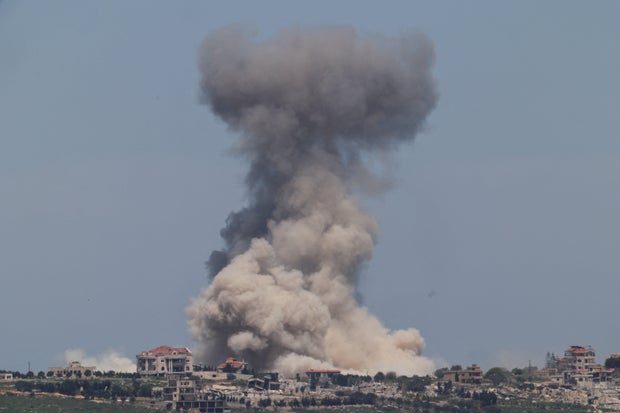
Lebanese state media reported a series of new Israeli strikes in the country’s south on Saturday night, after attacks earlier in the day killed six people despite a recently extended ceasefire in the war between Israel and Hezbollah.
The new attacks followed orders from Israeli Prime Minister Benjamin Netanyahu for the military to “forcefully attack Hezbollah targets” after the army accused it of breaching the truce.
Lebanon’s health ministry said Israeli strikes on a truck and a motorbike in the town of Yohmor al-Shaqeef killed four people, and an attack on the town of Safad al-Battikh killed two and injured 17.
Florion Goga / REUTERS
Israel’s military said it “eliminated” three Hezbollah operatives on Saturday who were driving “a vehicle loaded with weapons,” as well as another one riding a motorcycle, and two more armed members of the group elsewhere.
It also said it identified two projectiles launched from Lebanon, decrying “a blatant violation of the ceasefire understandings” by Hezbollah, and later intercepted another “suspicious aerial target.”
Hezbollah, meanwhile, said it targeted an Israeli army vehicle in south Lebanon in retaliation for the attack on Yohmor al-Shaqeef.
Following Netanyahu’s order to attack the group, Lebanon’s state-run National News Agency reported a pair of strikes in quick succession in a town in Bint Jbeil district, another on a town in Tyre district, and strikes on two more towns in Nabatieh district.
The Israeli military said that it had “struck Hezbollah terrorist infrastructure used for military purposes across southern Lebanon”, and would “continue to operate decisively against threats.”
By AFP
U.S. chopper intercepts sanctioned merchant vessel in Arabian Sea, CENTCOM says
The U.S. military Saturday intercepted a sanctioned merchant vessel in the Arabian Sea, U.S. Central Command said.
The M/V Sevan was intercepted by a U.S. Navy helicopter from the guided-missile destroyer USS Pinckney, said CENTCOM, which is responsible for U.S. military operations in the Middle East.
“The merchant vessel is currently complying with U.S. military direction to turn back to Iran under escort,” CENTCOM said in a social media post.
M/V Sevan is one of 19 vessels belonging to a shadow fleet that was sanctioned by the Treasury Department Friday. A shadow fleet is a group of vessels that use deceptive practices to traffic oil from countries that are under U.S. sanctions.
M/V Sevan flies a Panama flag and is owned by the Marshall Islands-based Anka Energy and Logistics Company, according to the Treasury Department. It transported about 750,000 barrels of Iranian propane and butane to Bangladesh between August and November of 2025, the Treasury Department said.
By Faris Tanyos
Iran state media says foreign minister expected to return to Islamabad after Oman visit
Iranian Foreign Minister Abbas Araghchi is expected to return to Islamabad after he visits Oman and before traveling to Russia, according to Iran’s state news agency IRNA.
IRNA said Araghchi arrived in Muscat on Saturday evening after meeting Pakistani officials and conveying Iran’s positions on the terms of any understanding to fully end the war and establish peace.
Part of the Iranian delegation that accompanied Araghchi to Islamabad returned to Tehran after the talks for consultations and to receive further instructions on issues related to the war, according to IRNA.
The delegation members are expected to rejoin Araghchi in Islamabad on Sunday night.
By Imtiaz Tyab
Iran’s foreign minister travels to Oman after peace talks canceled
Foreign Minister Abbas Araghchi traveled to Oman on an official visit after President Trump canceled U.S. envoys’ travels to Pakistan to participate in peace talks.
A spokesperson for the Iranian office said on social media that this was the first visit to the region following the recent U.S.-Israeli aggression, which has impacted the broader area.
“Iran continues to place great importance on its relations with Persian Gulf states and remains committed to strengthening mutual trust and constructive cooperation,” the post said.
The Persian Gulf states have faced attacks from Iran since the war began. Iran has launched drones and missiles and closed the Strait of Hormuz, causing economic impacts in the region.
By Cara Tabachnick
Pakistani prime minister spoke to Iranian president following meeting
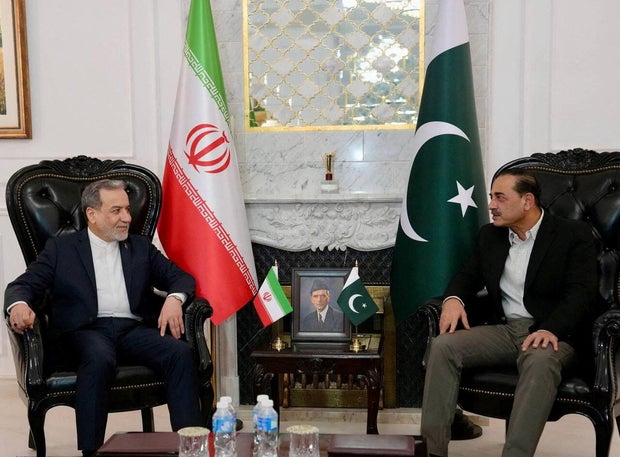
While no mention was made of President Trump’s decision to cancel Steve Witkoff and Jared Kushner’s trip to Islamabad, Pakistani Prime Minister Shebaz Sharif said he spoke to Iran’s president, Masoud Pezeshkian, by phone on Saturday night after the in-person meeting with Iranian Foreign Minister Abbas Araghchi earlier in the day.
“During their warm and cordial conversation that lasted fifty minutes, the two leaders had a detailed exchange of views on the current regional situation and ongoing efforts to promote peace and stability in the region,” Sharif said in a statement, though no details on a possible peace deal were released.
Seyed Abbas Araghchi via Telegram/Handout via REUTERS
It’s unclear if the call came before or after President Trump called off a trip by his envoys.
“I think the prime minister of Pakistan is great. They’d like to see something happen, but we’re not gonna be traveling 15, 16 hours to have a meeting with people nobody has ever heard of,” Mr. Trump said before boarding Air Force One to travel back to Washington.
By Mark Osborne
Trump says “paper” from Iranians was “not enough” to make a deal
President Trump said the offer he received from Iranian officials to agree to a lasting peace deal was “not enough,” and he called off Steve Witkoff and Jared Kushner’s trip to Islamabad as he awaits another call about a deal.
“They gave us a paper that should’ve been better, and interestingly, immediately when I canceled it, within 10 minutes we got a new paper that was much better,” Trump said from the tarmac before boarding Air Force One in Florida to return to Washington for the White House Correspondents’ Dinner.
While he wouldn’t say exactly what Iran offered in the negotiations, he echoed the familiar argument that Iran must end its nuclear program.
“They will not have a nuclear weapon, it’s very simple. … They offered a lot, but not enough,” Trump said.
Earlier in the conversation with reporters, he said he would deal with “whoever we have to, but there’s no reason to have to wait two days, have people traveling for 16, 17 hours, and we’re not doing it that way. When they want, they can call me.”
By Mark Osborne
Trump says he called off Witkoff, Kushner trip: “We have all the cards, they have none!”
President Trump confirmed he called off a trip for envoys Steve Witkoff and Jared Kushner to travel to Islamabad for peace talks.
“I just cancelled the trip of my representatives going [to] Islamabad, Pakistan, to meet with the Iranians,” he wrote on Truth Social Saturday. “Too much time wasted on traveling, too much work!”
“Besides which, there is tremendous infighting and confusion within their ‘leadership,'” he said. “Nobody knows who is in charge, including them. Also, we have all the cards, they have none! If they want to talk, all they have to do is call!!!”
White House press secretary Karoline Leavitt said on Friday the duo would head to Islamabad for “direct talks” in pursuit of a lasting peace deal more than 50 days after the U.S. and Israel started bombing Iran.
Iranian Foreign Minister Abbas Araghchi spoke with Pakistani Prime Minister Shebaz Sharif on Saturday, but has already departed for Oman. The Pakistanis have been serving as intermediaries for discussions between Iran and the U.S.
Read more here.
By Mark Osborne
Trump cancels U.S. envoys’ trip to Pakistan, Fox News reports
President Trump said Saturday that Steve Witkoff and Jared Kushner will no longer be going to Pakistan today