Ukraine units downed Iran drones in “several” Mideast states: Zelenskyy
Ukraine President Volodymyr Zelenskyy says Ukrainian military experts downed Iranian drones in several Middle East countries.
Kyiv dispatched dozens of anti-drone personnel to at least four countries in the Middle East after U.S. and Israeli strikes on Iran sparked a wave of retaliatory drone attacks.
“We demonstrated to some countries how to work with interceptors. Did we destroy them? Yes, we did. Did we do it in just one country? No, in several,” Zelenskyy told journalists in comments released Friday.
“This was not about a training mission or exercises, but about support in building a modern air defense system that can actually work. Yes, they were shooting down Shaheds,” he said, referring to the Iranian drones.
Zelenskyy said earlier this week that Ukrainian drone units would remain in the region even after the U.S. and Iran agreed a two-week ceasefire.
“In return for our support and expertise, we will receive various things. In some cases, it involves interceptors to protect our energy infrastructure; in others, there are financial arrangements,” he said, adding Ukraine could also receive oil supplies.
By AFP
Australia rules out playing an offensive military role in Iran war
Australia’s Acting Prime Minister Richard Marles has rejected former Prime Minister Tony Abbott’s call for the air force to take an offensive role in the Iran war.
Abbott wrote in a newspaper opinion piece Friday that Australia should have offered the United States Air Force support including Australian strike fighters.
Marles, who is defense minister and acting prime minister while Anthony Albanese is overseas, said Australia had sent the United Arab Emirates a surveillance jet but was “not part of this conflict against Iran.”
“We will act in our national interest and we respectfully disagree with the position of Mr. Abbott,” Marles told Australian Broadcasting Corp.
President Trump has repeatedly criticized Australia for not helping the United States since the Iran war began. Australia says it has received no request for help.
Marles is serving in the role of acting prime minister while Albanese is on an official visit to Singapore.
By The Associated Press
Strait of Hormuz still seeing significantly lower traffic despite ceasefire
Only about a dozen ships passed through the Strait of Hormuz in the first two days of the ceasefire agreement between the U.S. and Iran, far below the normal traffic level before the war, marine transit data shows.
As part of the agreement, which President Trump announced late Tuesday, Iran would allow vessels to cross through the channel, which is a crucial waterway for shipping about 20% of the world’s oil supply.
But early Wednesday, an Iranian news agency linked to the country’s military reported that traffic through the strait would be suspended in response to Israel’s attacks on Hezbollah in Lebanon.
White House press secretary Karoline Leavitt disputed Iran’s claim that the Lebanon conflict was part of the ceasefire agreement. Vice President JD Vance told reporters Wednesday that there was a “legitimate misunderstanding” about the terms of the ceasefire.
On Wednesday and Thursday, at least 12 ships passed through the waterway — just a fraction of what would have been seen before the war, data from ship tracking company, Marine Traffic, shows. From Feb. 1 to Feb. 27, the U.N.’s Trade and Development organization said the average number of vessels passing through the strait was 129 before beginning to slow as the war began on Feb. 28.
Read more here.
By Julia Ingram
Iran’s supreme leader says in written message that regime did not seek war with U.S., Israel
Iran’s new supreme leader, Ayatollah Mojtaba Khamenei, said in his latest written message that Iran did not want war with the U.S. and Israel, but would protect its rights as a nation, state television reported Thursday.
“We did not seek war and we do not want it,” he said in the message read out on state TV, weeks after his father, Ayatollah Ali Khamenei, was killed on Feb. 28, the first day of the war.
“But we will not renounce our legitimate rights under any circumstances, and in this respect, we consider the entire resistance front as a whole,” he added, in an apparent reference to Lebanon where Israel is fighting with Tehran’s ally Hezbollah.
Khamenei told Iranians that they must “not imagine that taking to the streets is no longer necessary” despite the announcement of the ceasefire.
Likely wounded in the strike that killed his father, Mojtaba Khamenei has still not been seen in public since his leadership appointment. He has issued written declarations, most of them read out by presenters on state television.
Iranian state television has said he is recovering from his injuries and posts photos of him, without specifying when they were taken.
Analysis from U.S. intelligence showed the elder Khamenei was wary of his son ever taking power because he was perceived as not very bright, and was viewed as unqualified to be leader, multiple sources familiar with the matter told CBS News last month.
The information gathered also indicated that the father was aware that his son had issues in his personal life, according to sources within the administration, the intelligence community and people close to the president.
CBS/AFP
Trump says Iran “better not” charge “fees” to oil tankers traversing Strait of Hormuz
President Trump Thursday evening said that Iran “better not” charge “fees” to tankers that are attempting to travel through the Strait of Hormuz.
“There are reports that Iran is charging fees to tankers going through the Hormuz Strait — They better not be and, if they are, they better stop now!” Mr. Trump wrote in a Truth Social post.
This comes after Mr. Trump, speaking to reporters Monday, had floated the idea of the U.S. being involved in charging tolls for ships going through the strait.
“We have a concept where we’ll charge tolls,” Mr. Trump said.
In a follow-up post, Mr. Trump wrote, “Iran is doing a very poor job, dishonorable some would say, of allowing Oil to go through the Strait of Hormuz. That is not the agreement we have!”
According to analysts at maritime intelligence company Lloyd’s List, during the war, Iran has been using Larak Island, which is located a few miles off Iran’s coast, as a tolling stop for tankers, CBS News previously reported.
According to data compiled by MarineTraffic, at least 22 ships have passed through the strait since Tuesday, the day the ceasefire was announced.
By Faris Tanyos
6 ships traveled through Strait of Hormuz Thursday, data shows
A total of six ships traveled through the Strait of Hormuz Thursday, according to data compiled by the global ship tracking firm MarineTraffic.
They included two oil, chemical or liquid gas tankers, three cargo ships, and one bunkering tanker, which is a vessel that supplies fuel for other ships.
Only five cargo ships passed through the strait Wednesday, according to MarineTraffic, and none were oil, chemical or liquid gas tankers.
On Tuesday, the day the ceasefire was announced, a total of 11 ships passed through the strait, including nine oil, chemical or liquid gas tankers, and two cargo ships.
Since Feb. 28, at least 212 oil, chemical or liquid gas tankers have crossed the strait, per MarineTraffic data, about 58% of all ships that have made it through the crossing. Of that 212, 29% were during the first two days of the war, on Feb. 28 and March 1.
Of the 212, 43 were flagged to Panama, 37 to Iran, 25 to Liberia, 15 to Palau, and the rest to other countries.
By Julia Ingram
Trump, Starmer hold call on Iran war, U.K. officials say
British Prime Minister Keir Starmer held a call with President Trump Thursday night on the Iran war, a spokesperson for Starmer confirmed.
Starmer, who is in Qatar meeting with Gulf leaders, spoke with Mr. Trump about “the need to restore freedom of navigation in the Strait of Hormuz, as well as the UK’s efforts to convene partners to agree a viable plan,” according to a statement from the Downing Street spokesperson.
The two leaders “agreed that now there is a ceasefire in place and agreement to open the Strait, we are at the next stage of finding a resolution,” the spokesperson added.
Throughout the war, Mr. Trump has been publicly critical of Starmer, accusing the British leader of being too hesitant to provide military assistance in the conflict.
By Faris Tanyos
Israeli military striking Hezbollah launch sites in Lebanon, IDF says
The Israeli military said late Thursday night local time it was striking Hezbollah positions in Lebanon, shortly after it had warned that the Iranian-backed militant group could expand launches of projectiles across Israel.
Israel Defense Forces said in a social media post that it had “begun to attack Hezbollah terror organization launch sites in Lebanon a short while ago.”
Lebanon’s state-run National News Agency reported several Israeli strikes across southern Lebanon, including Bint Jbeil, a symbolic town where Hezbollah said earlier it was engaging with Israeli soldiers.
An Agence France-Presse correspondent saw first responders looking for survivors at the site of an Israeli airstrike that targeted the southern Lebanese village of Choukine.
In Israel, over 20 rocket alerts sounded through Thursday morning in communities near the northern border with Lebanon.
AFP footage from the border area showed long rocket trails in the sky and plumes of smoke signaling interceptions.
Israel on Wednesday unleashed what it said was its “largest coordinated strike” on Lebanon since the war began, killing more than 300 people and wounding over 1,000, according to Lebanon’s health ministry.
Hours later, Hezbollah said it had fired rockets towards Israel in response to what it called a violation of the U.S.-Iran truce.
Lebanese and Israeli representatives were expected to meet at the U.S. State Department in Washington next week for U.S.-mediated talks aimed at de-escalating the fighting between Israel and Hezbollah, a State Department official told CBS News.
CBS/AFP
“Beyond imagination:” Chef feeding displaced citizens describes crisis in Lebanon
People in Lebanon are living through a “dark moment” amid rising displacement, the head chef leading the World Central Kitchen’s response in Lebanon told CBS News on Thursday.
Aline Kamakian said that food scarcity is rapidly becoming the most urgent issue for thousands of families who have lost their homes. The “announcement of a ceasefire gave everyone a lot of hope,” Kamakian said, but a wave of Israeli strikes on Wednesday that hit over 100 sites in a matter of minutes was a surprise. Israel says the strikes are targeting Hezbollah members, while Lebanon’s prime minister said civilians are among the dead.
Since the start of the ceasefire, Israel has repeatedly issued warnings telling Lebanese residents to evacuate their homes. On Thursday, another evacuation order was issued for several districts in southern Beirut, leading to even more displacement.
“People are desperate. They don’t know where to go,” Kamakian said. Markets, schools and stadiums have been turned into makeshift shelters, even though they are not properly equipped to provide safe or sustainable conditions, she said.
Kamakian said that organizations like World Central Kitchen have become a lifeline. The organization recently served its millionth meal in Lebanon, Kamakian said, calling it a “bittersweet” milestone amid the devastation.
“Even if this stops now, there is no infrastructure, no electricity, no water, no bridges,” Kamakian said, stressing that even if food becomes available, many people will not be able to afford it. The WCK’s food reserves may also run out, limiting their ability to help.
“Humanity doesn’t exist anymore—it’s beyond imagination,” she added.
By Elena Giuliano
Iran’s Supreme Leader calls Iranian people “definitive victors”
Supreme Leader Mojtaba Khamenei called the Iranian people the “definitive victors” in the war in his latest written statement, which was read aloud on state television on Thursday.
Khamenei, who replaced his father Ali Khamenei after his death on the first day of the war, has not been seen or heard in public since becoming Iran’s supreme leader. He also shared multiple posts on X on Thursday.
Khamenei said that the nation does “not want” war and “did not seek” it, but would not “allow the criminal aggressors who attacked our country to go unpunished.” He called on Iran’s Gulf neighbors to “stand on the right side” of the conflict and “renounce the Arrogant Powers.”
He referenced upcoming talks with the U.S. and said there would be a “new era” in the Strait of Hormuz, which the U.S. has demanded be reopened.
By Kerry Breen
U.S. to lead diplomatic talks between Lebanon and Israel
Lebanese and Israeli representatives are expected to meet at the State Department next week for U.S.-mediated talks aimed at de-escalating cross-border violence involving Israel and the Iran-backed militant group Hezbollah, a State Department official told CBS News.
Two sources familiar with the planning, along with a Lebanese official, said the meeting is intended to explore how to launch direct talks focused on reducing tensions along the Israel–Lebanon border.
U.S. Ambassador to Lebanon Michael Issa will lead the talks, along with Lebanese Ambassador Nada Hamadeh Moawad and Israeli Ambassador Yechiel Leiter, according to the sources.
Lebanon has emerged as one of the thorniest complicating issues in the nascent diplomacy with the U.S. and Iran. Iranian Foreign Minister Abbas Araghchi – expected to join the upcoming talks in Islamabad – accused the U.S. of letting Israeli Prime Minister Benjamin Netanyahu kill diplomacy.
Multiple diplomatic sources told CBS that President Trump had been told the ceasefire would apply to the Middle East region, and he agreed that included Lebanon. Mediators believed the ceasefire to include Lebanon, and Prime Minister Shehbaz Sharif of Pakistan announced it did. Iran’s foreign minister also said it was included. On the day of the ceasefire, a White House official told CBS News that Israel had also agreed with the terms of the deal that Pakistan had helped to broker.
However, the U.S. position shifted following a phone call between Netanyahu and Mr. Trump. Two sources familiar told CBS News that the changing U.S. positions and the disjointed regime in Iran are making the diplomacy highly complex.
Vice President JD Vance told reporters Wednesday that there was a “legitimate misunderstanding” about the terms of the ceasefire, but he placed blame on the Iranians for misunderstanding that it included their proxy forces in Lebanon.
On Thursday, Netanyahu said he had agreed to allow Israeli diplomats to accept the Lebanese government’s request to hold talks. He did not provide specifics, and insisted there is no ceasefire in Lebanon.
Read more here.
Michal Ben-Gal contributed reporting.
Trump says he has asked Netanyahu to scale back Lebanon strikes
During a phone call with “The Kraus Report” host Neria Kraus, President Trump said that he had spoken with Netanyahu and urged the Israeli prime minister to reduce strikes on Lebanon.
According to Kraus, Mr. Trump said “Netanyahu is going to be fine. He’s gonna low key a little bit. He’s got a problem with Hezbollah. He’s gonna low key a little bit, but he’s gonna be absolutely fine.”
Kraus also said Mr. Trump claimed that “Netanyahu is on board” with the ceasefire between the U.S. and Iran.
“We’re going to have a very successful agreement,” Mr. Trump said, according to Kraus. “It’s gonna be very good, everything’s gonna work out very good.”
By Kerry Breen
Over 300 killed in Israel’s strikes, Lebanese health ministry says
The death toll from Wednesday’s Israeli strikes in Lebanon has climbed to over 300 people, the Lebanese Health Ministry said Thursday.
Israel said it launched 100 strikes across Lebanon in 10 minutes and said they were targeting Hezbollah operatives and infrastructure. The strikes hit busy residential and commercial areas. Earlier Thursday, the death toll stood at over 200.
Israeli Defense Minister Israel Katz said Thursday that the wave of airstrikes killed “200 terrorists.” Lebanese prime minister Nawaf Salam said that the strikes “led to a large number of civilian casualties.”
The Lebanese Health Ministry said the toll is likely to continue to rise as search and rescue teams find remains under the rubble, and as more bodies are identified at hospitals.
By Kerry Breen
U.N. warns that fighting in Lebanon poses a “grave risk” to ceasefire
United Nations Secretary-General Antonio Guterres called for an immediate ceasefire in Lebanon and welcomed potential Israel-Lebanon talks, saying there is “no military solution” to the conflict, according to his spokesman.
Ongoing Israeli military activity jeopardizes the U.S.-Iran ceasefire, spokesman Stephane Dujarric said, adding that Israeli evacuation orders in Beirut’s southern suburbs cover U.N. sites, refugee camps, aid hubs, a major public hospital, and 13 shelters hosting over 6,000 displaced people.
By The Associated Press
1st non-Iranian tanker transits Strait of Hormuz since ceasefire
The first non-Iranian oil tanker passed through the Strait of Hormuz on Thursday, MarineTraffic data shows.
The MSG, a Gabon-flagged oil tanker, passed through the strategic waterway loaded with around 7,000 tonnes of Emirati fuel oil. It was headed to Aegis Pipavav, India, according to the maritime monitor.
Traffic through the crucial shipping lane signals it has not meaningfully reopened since the two-week truce took effect on Wednesday. Just two other tankers – both Iran-flagged – and six bulk carriers have been through the Strait since Wednesday, according to MarineTraffic owner Kpler.
By AFP
Democrats vow to keep trying to stop Trump’s war with Iran
House Democrats gathered at the U.S. Capitol and lambasted the Trump administration’s ceasefire negotiations with Iran as chaotic and unworkable, and characterized the president’s threats about wiping out a civilization as the musings of madness.
The lawmakers warned they would keep proposing resolutions to end the war, and use their votes to block any requests from the administration for more money to fund it.
“It’s clear that their ability to negotiate with Iran is nonexistent,” said Rep. Glenn Ivey of Maryland, who called Trump’s plans for tolls on the Strait of Hormuz particularly outrageous.
Rep. Madeleine Dean from Pennsylvania, who supports efforts to force Trump to step aside under the Constitution’s 25th Amendment, pointed back to the president’s days of escalatory rhetoric.
“The president brought the entire globe to watch his madness,” she said.
By The Associated Press
Republicans block House Democrats from bringing up war powers resolution
House Democrats were aiming to attempt to approve a resolution to limit President Trump’s ability to take further military action against Iran on Thursday, with a plan to make a unanimous consent request on the measure. But as a small number of lawmakers gathered for the pro forma House session, the presiding Republican, Rep. Chris Smith of New Jersey, quickly moved to adjourn the chamber.
Democratic Rep. Glenn Ivey of Maryland had planned to attempt to approve the war powers resolution via unanimous consent, at which point a Republican would almost certainly have objected. House Minority Leader Hakeem Jeffries previewed the plan in a letter to House Democrats on Wednesday, citing an “urgent need to permanently end Donald Trump’s reckless war of choice with Iran.”
The attempted move came after Democrats, and a handful of Republicans, expressed outrage over the president’s threat earlier this week that a “whole civilization will die” unless a deal was reached with the Islamic Republic. And despite the two-week ceasefire, Democrats have continued to question the president’s approach to the war, and called for GOP leaders to bring Congress back from recess.
The House and Senate have previously rejected attempts to curb the president’s Iran war powers. Next week, Democrats are expected to force additional war powers votes in both chambers.
By Kaia Hubbard
More than 80 countries strongly condemn “persistent attacks” in Lebanon
In a joint statement Thursday, dozens of countries condemned “persistent attacks” in Lebanon and the killings of U.N. peacekeepers there. The statement was read aloud by Indonesia’s U.N. Ambassador Umar Hadi, whose country recently had three of its peacekeepers killed in southern Lebanon.
The statement said those responsible for attacks on peacekeepers must be held accountable, but did not identify any parties. A preliminary U.N. report blamed Israel for two of the killings and Hezbollah for one of them.
The U.S. was not on the list of signatories in the statement. The signatories reaffirmed support for UNIFIL, said attacks against peacekeepers may constitute war crimes, and called on the parties to urgently return to the 2024 ceasefire.
By The Associated Press
U.S. lost 8 more Reaper drones this month, sources say
The U.S. Department of Defense has lost eight MQ-9 Reaper drones in the Middle East since April 1, bringing the total number of such devices lost in the Iran war up to 24, according to two U.S. officials who spoke to CBS News under condition of anonymity because they were not authorized to speak publicly.
The drones represent a loss of about $720 million. Depending on the variant, a single Reaper drone can cost about $30 million or more.
The MQ-9 Reaper, made by General Atomics Aeronautical Systems, is a remotely piloted aircraft used for intelligence, surveillance and reconnaissance missions. It can also deliver precision strikes. These types of drones are easier to knock out of the sky because they were designed for counter-terrorism environments where there is little to no air defense, not for countries with modern missile systems.
By James LaPorta
Countries are looking to offer “practical support” on Strait of Hormuz, Rutte says
NATO Secretary General Mark Rutte emphasized Thursday that a coalition of countries, led by United Kingdom Prime Minister Keir Starmer, is looking to offer “practical support” to keep the Strait of Hormuz open as President Trump pushes allies to do more. Rutte noted that the bulk of the countries in the coalition are NATO allies.
“Each country is now looking for what they can do to contribute to make sure that the Strait of Hormuz stays open,” Rutte said at a Reagan Institute event Thursday.
Mr. Trump has lashed out about a perceived lack of support from NATO allies since the war with Iran began. Mr. Trump has said at times that he is considering withdrawing the U.S. from the alliance. Rutte met with the president on Wednesday. On Thursday, he described that conversation as “frank and open.”
“I sensed his disappointment about the fact that he felt that too many allies were not with him,” Rutte said, adding that he expressed to the president that “the overwhelming majority of Europeans have done what the U.S. asked of them.”
By Kaia Hubbard
Netanyahu says he instructed Cabinet to negotiate directly with Lebanon
Israeli Prime Minister Benjamin Netanyahu said Thursday he has instructed Israel’s Cabinet to open direct negotiations with Lebanon.
“In light of Lebanon’s repeated calls to open direct negotiations with Israel, I instructed the Cabinet yesterday to open direct negotiations with Lebanon as soon as possible,” he said.
The negotiations will focus on disarming Hezbollah and establishing a peaceful relationship between Lebanon and Israel, Netanyahu said.
His statement comes as Israel is continuing strikes in Lebanon amid its ongoing war with Hezbollah. Israel’s military said Wednesday it hit 100 purported Hezbollah targets across the country in just 10 minutes – attacks that Lebanon said killed more than 200 people.
Lebanon has emerged as a flashpoint in President Trump’s effort to end the Iran war. The U.S. and Israel have publicly disagreed with Iran and Pakistan over whether the country to Israel’s north is included in the Iran war ceasefire.
By Kerry Breen
Iran’s parliament speaker warns of “strong responses” if strikes on Lebanon continue
Iran’s parliament speaker warned Thursday on X that continued Israeli attacks on Hezbollah in Lebanon would bring “explicit costs and STRONG responses.”
Like other Iranian officials, Mohammad Bagher Qalibaf insisted that the two-week ceasefire extended to Lebanon, something denied by both Israel and the U.S.
“Ceasefire violations carry explicit and STRONG responses,” he wrote. “Extinguish the fire immediately.”
Qalibaf has been discussed as a possible negotiator who could meet U.S. Vice President JD Vance this weekend for talks in Islamabad, the capital of Pakistan.
By The Associated Press
Lebanon says 203 people killed in Israeli strikes Wednesday. Israel says it killed 200 terrorists.
Israel’s defense chief said Thursday that the country’s massive wave of airstrikes the previous day in neighboring Lebanon had killed “200 terrorists,” dealing what he called “a very strong blow to” Iran’s proxy force in the country, Hezbollah.
The number offered by Defense Minister Israel Katz in his televised remarks was almost identical to the death toll reported from the strikes by Lebanon’s Health Ministry, and while the ministry does not give a breakdown of civilians and militants in its casualty figures, reports from Lebanese media and posts online showed vast destruction in residential neighborhoods, with civilians among those impacted.
Lebanon’s Prime Minister Nawaf Salam said that the Israeli strikes “led to a large number of civilian casualties.”
In his remarks, Katz also reinforced the Israeli and U.S. government’s position that the war in Lebanon was not included in the two-week ceasefire agreement reached Tuesday night between the Trump administration and Iran. The Iranian regime — and Pakistan, which brokered the deal — disagree, and have accused Israel and the U.S. of violating the ceasefire by continuing strikes in Lebanon.
“The agreement on the separation of the arenas is an important achievement led by the Prime Minister, and allows us to act forcefully against Hezbollah according to an orderly plan,” Katz said.
Katz said weeks ago that Israeli forces would occupy a large section of southern Lebanon, from which all residents have been ordered to evacuate, indefinitely, until the threat posed by Hezbollah to northern Israel is removed. He reiterated that plan on Thursday, saying the Israel Defense Forces would “prevent the infiltration of additional terrorists and the return of residents to the south.”
By Tucker Reals
U.S. has struck more than 13,000 targets since Iran war began
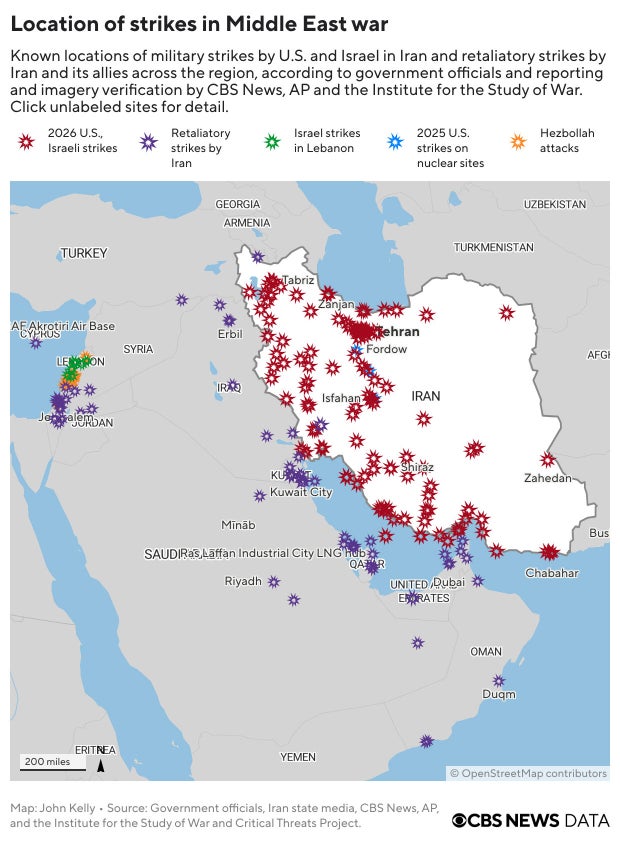
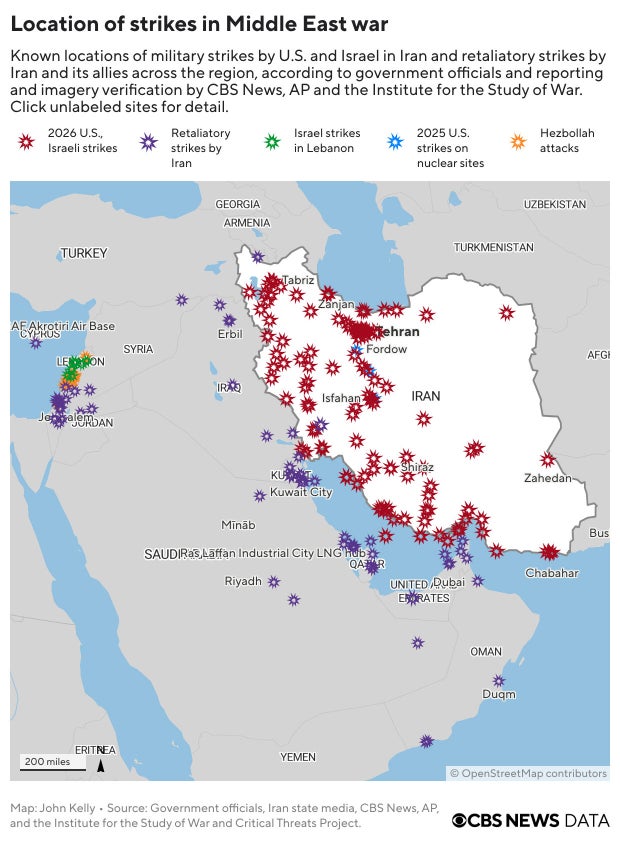
Data compiled by CBS News shows more than 13,000 targets struck by the U.S. and Israel during the military operation in Iran, as well as strikes by Iran in 12 countries across the region since the war began. A two-week ceasefire deal was announced on Tuesday but Israel continues striking targets in Lebanon it says are linked to Iran-backed Hezbollah.
By John Kelly
Germany calls Iran war “stress test” for NATO, says Israeli actions could cause “failure of the peace process”
German Chancellor Friedrich Merz acknowledged that the Iran war has become a “stress test” for NATO and said he doesn’t want it to burden trans-Atlantic relations further.
Merz said he and Trump discussed the alliance’s future in a phone call Wednesday and that he offered to discuss it again before a NATO summit in Ankara, Turkey, in July.
Merz said that “it is my firm intention to do everything to preserve the protection of NATO, including the United States of America, for Europe.”
He added that “this alliance, at least at present, cannot be replaced by anything, so I have a great interest in preserving it and developing it further with the American president.”
Chancellor Friedrich Merz said that “the severity with which Israel is waging war there could cause the failure of the peace process as a whole, and that must not happen.”
He said that he and others had asked Israel on Wednesday to “end its further intensified attacks” and that his foreign minister had spoken twice to his Israeli counterpart.
Merz also spoke to Trump on Wednesday. The chancellor said on Thursday that the German government would start talking to Iran again, in consultation with the U.S. and its European partners, in the interest of making “our own contribution” to the success of peace negotiations.
Merz didn’t specify with whom Germany intends to speak or when.
By The Associated Press
U.S. Army survivors of deadly Iranian attack in Kuwait dispute Pentagon’s account
Survivors of the deadliest Iranian attack on U.S. forces since the war began have disputed the Pentagon’s description of events and said their unit in Kuwait was left dangerously exposed. Six service members were killed and more than 20 wounded in the attack.
Speaking publicly for the first time, members of the targeted unit offered CBS News a detailed account of the attack and its harrowing aftermath. They disputed the description of events from Defense Secretary Pete Hegseth, who called the drone a “squirter” — suggesting it squirted through the defenses of a fortified unit inside Kuwait.
“Painting a picture that ‘one squeaked through’ is a falsehood,” one of the injured soldiers told CBS News. “I want people to know the unit … was unprepared to provide any defense for itself. It was not a fortified position.”
The service member, who spoke on the condition of anonymity because of rigid media restrictions within the military, said that in spite of the carnage that ensued, those inside the charred and splintered compound responded with swiftness, ingenuity and valor that saved lives.
“I don’t think that the security environment or any leadership decision diminishes in any way their sacrifice or their service,” the member of the Army’s 103rd Sustainment Command said in an interview. “Those soldiers put themselves in harm’s way and … I’m immensely proud of them, and their family should be proud of them.”
Read more here.
Trump wants to see concrete plans for securing Strait of Hormuz, NATO chief tells U.S. allies
NATO Secretary General Mark Rutte has told several of America’s allies that President Trump wants to see ironclad commitments in the coming days for help to secure the Strait of Hormuz, the Reuters news agency quoted two European diplomats as saying on Thursday.
After meeting Wednesday with Mr. Trump at the White House, Rutte told CNN the president was “clearly disappointed with many NATO allies” for refusing to join the U.S.-Israeli war against Iran, adding: “I can see his point.”
Since the war began, Mr. Trump has derided NATO allies as “cowards” and the alliance itself as a “paper tiger.” He’s suggested he could move to unilaterally withdraw the U.S. from the alliance he helped to found more than 70 years ago.
After his meeting with Rutte, Mr. Trump posted on Truth Social: “NATO WASN’T THERE WHEN WE NEEDED THEM, AND THEY WON’T BE THERE IF WE NEED THEM AGAIN.”
Weighing in again with a new post on Thursday morning, he said “none of these people, including our own, very disappointing, NATO, understood anything unless they have pressure placed upon them!!!”
Estonian Foreign Minister Margus Tsahkna told CNBC on Wednesday: “If the U.S. or any other NATO ally is asking (for) our support, we are always ready to discuss it … But for that, we need of course the official ask to discuss then, what is the mission, what is the goal?”
If allies “need our support,” he added, “then we need to plan together.”
President Trump did not consult with America’s NATO allies before launching the joint war with Israel against Iran, only demanding that they join the effort after the fact.
By Frank Andrews
Lebanon to take complaint to U.N., says Israel “blatantly violates the principles of international law”
Lebanon’s Prime Minister Nawaf Sallam said Thursday that his government would “urgently file a complaint with the United Nations Security Council regarding the escalation of Israeli attacks on Lebanon and their expansion yesterday.”
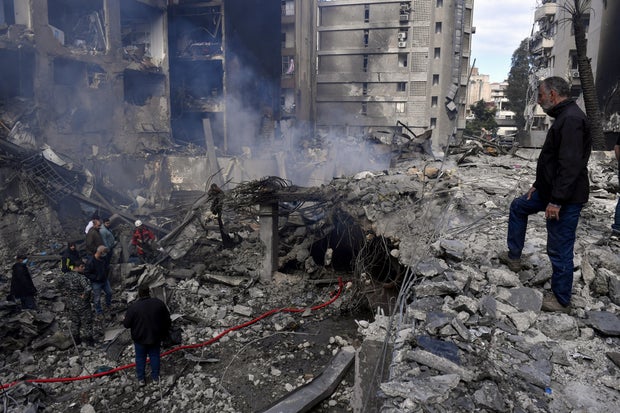
Israel’s military said it carried out its most intense day of strikes in Lebanon Wednesday, which it says targeted an expanding Hezbollah presence in the neighboring nation. Hezbollah, long designated as a terrorist group by Israel, the U.S. and the European Union, is a deeply entrenched political force in Lebanon, but it is also a well-armed Iranian proxy group that routinely attacks Israel with rocket fire.
Israel has ramped up its offensive against Hezbollah for weeks, including a ground invasion with forces occupying a significant portion of the country’s south. Lebanon says more than 1 million people have been forced to flee their homes due to the Israeli operation, and that at least 203 people were killed on Wednesday alone. The death toll from the last five weeks was over 1,500 even before Wednesday’s strikes.
“This escalation runs counter to all international and regional efforts to stop the war in the region, blatantly violates the principles of international law and international humanitarian law, and goes even further in breaching them,” Sallam said Thursday.
Houssam Shbaro/Anadolu/Getty
He also said the cabinet was ordering Lebanon’s security forces “to preserve the safety, security, and property of citizens,” including by reinforcing “the full control of the state over Beirut” and ensuring that weapons were around the capital were held exclusively by “legitimate forces.”
Israel regularly accuses Lebanon’s government of failing to remove the threat to its security posed by Hezbollah.
By Tucker Reals
Lebanon to take complaint to U.N. as Israel “blatantly violates the principles of international law”
Lebanon’s Prime Minister Nawaf Sallam said Thursday that his government would “urgently file a complaint with the United Nations Security Council regarding the escalation of Israeli attacks on Lebanon and their expansion yesterday.”
Israel’s military said it carried out its most intense day of strikes in Lebanon Wednesday, which it says targeted an expanding Hezbollah presence in the neighboring nation. Hezbollah, long designated as a terrorist group by Israel, the U.S. and the European Union, is a deeply entrenched political force in Lebanon, but it is also a well-armed Iranian proxy group that routinely attacks Israel with rocket fire.
Israel has ramped up its offensive against Hezbollah for weeks, including a ground invasion with forces occupying a significant portion of the country’s south. Lebanon says more than 1 million people have been forced to flee their homes due to the Israeli operation, and that at least 203 people were killed on Wednesday alone. The death toll from the last five weeks was over 1,500 even before Wednesday’s strikes.
“This escalation runs counter to all international and regional efforts to stop the war in the region, blatantly violates the principles of international law and international humanitarian law, and goes even further in breaching them,” Sallam said Thursday.
By Tucker Reals
Lebanon says at least 203 people killed in Israel’s attacks on Wednesday alone
Lebanon’s Minister of Health Rakan Nasser al-Din said Thursday that the death toll from Israel’s strikes on the country on Wednesday had risen to 203, with over 1,000 people wounded, according to Lebanese media.
By Haley Ott
Pakistan and EU share “concern over serious violations of the ceasefire” Pakistan says
Pakistan’s government said the country’s top diplomat spoke Thursday in a phone call with his European Union counterpart and that both voiced their “concern over serious violations of the ceasefire in Lebanon.”
Both Iran and Pakistan, which brokered the ceasefire President Trump said his administration had agreed to on Tuesday night, say the deal included a cessation of all U.S. and Israeli military action against Iran and its allies, including Hezbollah in Lebanon.
The White House and Israel’s government say Israel’s ongoing war in Lebanon was never part of the agreement.
According to the readout of the call from the Pakistani Foreign Ministry, Minister and Senator Mohammad Ishaq Dar and EU High Representative for Foreign Affairs Kaja Kallas stressed the importance of the conditional U.S.-Iran ceasefire’s “full implementation.”
In a social media post, Kallas said separately that “Hezbollah dragged Lebanon into the war, but Israel’s right to defend itself does not justify inflicting such massive destruction. Israeli strikes killed hundreds last night, making it hard to argue that such heavy-handed actions fall within self-defense.”
The EU diplomat said Israel’s actions were putting the ceasefire “under severe strain” and that the agreement “should extend to Lebanon.”
By Tucker Reals
Spain accuses Israel of “flouting the ceasefire,” says ambassador will return to Iran
Spain’s Foreign Minister Jose Manuel Albares on Thursday accused Israel of “flouting” the U.S.-Iran ceasefire and violating international law with a massive round of airstrikes on Lebanon.
Spain has been among the most vocal critics in Europe of the joint U.S.-Israeli war on Iran, and Israel’s parallel war against Iranian-backed Hezbollah in Lebanon. Madrid closed its airspace to aircraft involved in the war.
“Yesterday we saw how Israel, flouting the ceasefire and in violation of international law, dropped hundreds of bombs on Lebanon,” Albares told said in Spain’s parliament on Thursday, hours after announcing that the country’s ambassador would return to Tehran “to take up his post again and reopen our embassy, and for us to join in this effort for peace from every possible quarter, including from the Iranian capital itself.”
Israeli foreign minister Gideon Saar slammed Spain for the move, saying in a post on social media: “The Iranian terror regime is renewing the executions of its citizens, protesters, and political opponents. Spain is reopening its embassy in Tehran. Hand in hand. Without shame. To the disgrace of the world.”
By Tucker Reals
Oil prices back up and stock markets cool down as Iran ceasefire optimism dissipates
Oil prices rebounded Thursday and stock markets were flat or slightly lower in Asia as the dispute over the Iran war ceasefire revived concerns that the conflict could reignite, and as investors assessed the likely lingering effects of damage already done to the global economy.
Despite President Trump’s insistence, there was little indication that oil and other commodities would start moving freely again through the Strait of Hormuz, as Iran kept its grip on the vital waterway.
“You have a fifth of the world’s oil supply moving through a corridor that is still effectively under the influence of one of the parties to the conflict,” Nigel Green, CEO at the deVere Group financial firm told the Reuters news agency. “That’s not stability.”
That lack of certainty pushed U.S. crude futures back up 3.1% to $97.33 a barrel early Thursday, as global benchmark Brent Crude inched back up more than 2% to trade around the $98 mark.
In Asia, which gets much of its energy directly from the Persian Gulf, stock prices slumped Thursday after a sharp spike the previous day on optimism over Mr. Trump’s initial ceasefire announcement. Japan’s Nikkei was largely flat, South Korean shares dipped 0.4%, Chinese blue chips slipped 0.6%, and MSCI’s broadest index of Asia-Pacific shares outside Japan eased 0.7%, according to Reuters.
Wednesday’s surge also looked definitively over on Wall Street, with S&P 500 futures and Nasdaq futures both down about 0.2% early Thursday.
Oil prices have been up and down in recent weeks, but overall, since the U.S. and Israel launched their war on Iran, they are up about 40%, and analysts say that will drive up prices for a wide range of consumer goods and services for months to come.
By Tucker Reals
Iran’s deputy foreign minister says U.S. must choose “between war and ceasefire”
Iran’s deputy foreign minister Saeed Khatibzadeh told CBS News partner network BBC that Israel’s attacks on Lebanon Wednesday were “a grave violation” of the ceasefire agreement, adding that the U.S. must choose “between war and ceasefire – you cannot have it both at the same time.”
“You cannot ask for a ceasefire and then accept terms and conditions, accept areas the ceasefire is applied to, and name Lebanon, exactly Lebanon in that, and then your ally just start a massacre,” Khatibzadeh said.
When asked if Iran would tell Hezbollah, its proxy group in Lebanon, to stop firing rockets into Israel, Khatibzadeh said “it is quite clear that Hezbollah is [a] pure Lebanese freedom movement.”
He did not deny that Iranian Revolutionary Guard officers help train and arm Hezbollah fighters, but said “it is not true that they are acting on behalf of us.” He said the agreement between the U.S. and Iran applied to each country and its allies.
Despite Israel’s attacks in Lebanon, Khatibzadeh said Iran remained “very much focused on getting [an agreement] done.”
On the Strait of Hormuz, Khatibzadeh said: “Definitely, we are going to provide security for safe passage and it is going to happen after the United States actually withdraws this aggression.”
He said Iran would determine a “protocol which is going to run from now on on safe passage in the Strait of Hormuz” with Oman “and, of course, with [the] international community.”
“I think that we have shown to everybody that energy security is important for Iran, it’s important for this body of water in the Persian Gulf, and we are going to abide by the international norms and international law … If safe passage mean[s] that a new protocol that ensure[s] forever that this body of water will be peaceful, then that’s okay” but that safety should be two-sided, Khatibzadeh said.
The diplomat said Iran had “many doubts” about the prospects for a final peace agreement with the U.S., suggesting Tehran believed Washington could just be exhausting diplomatic channels but planning to revert to military force, or “dictating and not compromising.”
By Haley Ott
Netanyahu says Israel will continue to strike Hezbollah “wherever required”
Israeli Prime Minister Benjamin Netanyahu said Thursday that Israel was continuing “to strike Hezbollah with force, precision, and determination,” despite allegations from Iran and the international community that it was violating the ceasefire agreement between the U.S. and Iran and jeopardizing a chance at a deal to end the war.
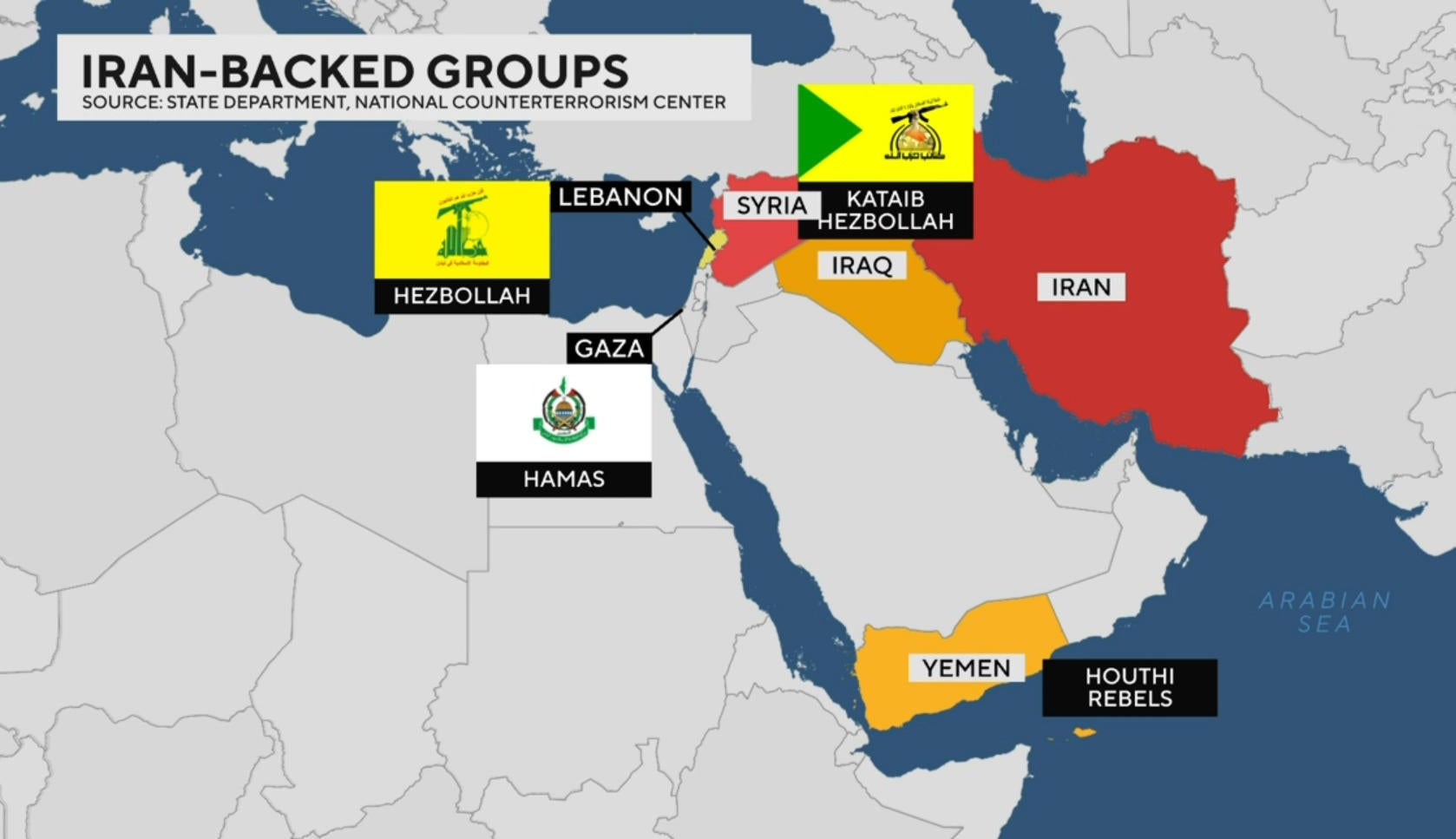
“In Beirut, we eliminated Ali Youssef Kharshi, the personal secretary of Hezbollah terror organization Secretary-General Naim Qassem and one of the people closest to him. At the same time, overnight, the IDF struck a series of terror infrastructures in southern Lebanon: crossings used to transfer thousands of weapons, rockets, and launchers, as well as weapons depots, launchers, and Hezbollah headquarters,” Netanyahu said.
“Our message is clear: Whoever acts against Israeli civilians will be struck. We will continue to strike Hezbollah wherever required, until we restore full security to the residents of the north.”
By Haley Ott
Hezbollah says it has fired more rockets at Israel
Sirens blared early Thursday morning in a few Israeli communities along the northern border with Lebanon, near the city of Kiryat Shmona, which has been targeted repeatedly during the war by rockets fired by the Iranian-backed militia Hezbollah.
In a statement, Hezbollah, long designated a terrorist group by the U.S. and Israel, said it had attacked Manara in northern Israel Thursday morning with rocket fire.
“This response will continue until the Israeli-American aggression against our country and our people ceases,” the group said.
Following the announcement of the U.S.-Iran ceasefire on Tuesday, Israeli Prime Minister Benjamin Netanyahu said that the deal did not extend to the conflict in Lebanon. Iran, and Pakistan, which brokered the ceasefire, disagree on that point.
Lebanon’s health ministry said at least 180 people were killed in Israeli strikes on Wednesday alone – a wave of attacks that Israel’s military called its largest in a month, hitting 100 purported Hezbollah targets in just 10 minutes. The health ministry said commercial and residential areas in central Beirut were hit without warning.
CBS/AP
Vance says “a lot of points of agreement” between U.S. and Iran as he prepares to lead U.S. peace talks delegation
President Trump has said Vice President JD Vance and senior envoys Steve Witkoff and Jared Kushner will all attend peace talks with Iran this weekend in Islamabad, Pakistan.
Vance sounded optimistic as he left Hungary on Wednesday, telling reporters there were actually “a lot of points of agreement” between the U.S. and Iran and that “ceasefires are always messy.”
Iran has said it will participate in the talks but has yet to confirm who will lead its delegation or when they will arrive.
By Tucker Reals
Israeli strikes on Lebanon pose “grave risk” to U.S.-Iran ceasefire deal, U.N. chief says
The United Nations secretary-general on Wednesday warned that ongoing Israeli military activity in Lebanon “poses a grave risk” to the fragile US-Iran truce, his spokesperson said in a statement.
“The ongoing military activity in Lebanon poses a grave risk to the ceasefire and the efforts toward a lasting and comprehensive peace in the region. The Secretary-General reiterates his call to all parties to immediately cease hostilities,” a spokesperson for U.N. Secretary-General Antonio Guterres said in a statement.
The Lebanese health ministry reported that at least 182 people were killed and 890 wounded by Israeli strikes on Wednesday.
By AFP
Trump indicates all current U.S. military assets will remain in place in Middle East
President Trump said late Wednesday that all U.S. military personnel and hardware would remain in the Middle East amid the ongoing ceasefire and negotiations with Iran.
“All U.S. Ships, Aircraft, and Military Personnel, with additional Ammunition, Weaponry, and anything else that is appropriate and necessary for the lethal prosecution and destruction of an already substantially degraded Enemy, will remain in place in, and around, Iran, until such time as the REAL AGREEMENT reached is fully complied with,” the president wrote on Truth Social.
Mr. Trump went on to say that if the terms of the deal were not met, “then the ‘Shootin’ Starts,’ bigger, and better, and stronger than anyone has ever seen before.”
He reiterated that the deal requires that Iran not develop or obtain a nuclear weapon and that the Strait of Hormuz be “OPEN & SAFE.”
“In the meantime our great Military is Loading Up and Resting, looking forward, actually, to its next Conquest,” Mr. Trump added.
By Faris Tanyos
Iran announces alternative routes through Strait of Hormuz for ships to avoid mines
Iran announced alternative routes on Thursday local time for ships traveling through the Strait of Hormuz, citing the risk of sea mines in the main zone of the vital waterway.
“All ships intending to transit the Strait of Hormuz are hereby notified that in order to comply with the principles of maritime safety and to be protected from possible collisions with sea mines…they should take alternative routes for traffic in the Strait of Hormuz,” Iran’s Revolutionary Guards said in a statement quoted by Iranian state media.
The statement shared instructions for an alternative entry and exit route through the strait.
Last month, U.S. officials told CBS News that there were at least a dozen underwater mines planted by Iran in the strait according to American intelligence assessments.
CBS/AFP