Strikes intensify across Middle East
Witnesses in eastern Tehran reported a partial power outage following airstrikes. In Israel, loud explosions filled the air in Tel Aviv and emergency crews responded to nearly a dozen impact sites.
An Associated Press journalist heard loud explosions in Tel Aviv, and Israel’s Fire and Rescue Service said it was responding to 11 different impact sites across the metro area.
Defense Minister Israel Katz had earlier vowed that Iran “will pay heavy, increasing prices for this war crime.”
Israel focused its attacks Friday on sites “in the heart of Tehran” where ballistic missiles and other weapons are produced, the military said. It said it also hit missile launchers and storage sites in Western Iran.
Saudi Arabia’s Defense Ministry, meanwhile, said it shot down missiles and drones targeting the capital, Riyadh. In Lebanon, the Health Ministry said two people were killed.
Kuwait said its Shuwaikh Port in Kuwait City and the Mubarak Al Kabeer Port to the north, which is under construction as part of China’s “Belt and Road” initiative, sustained “material damage” in attacks. It appeared to be one of the first times a Chinese-affiliated project in the Gulf Arab states has come under assault in the war. China has continued to purchase Iranian crude.
By The Associated Press
Israeli military launches new round of strikes on Tehran, IDF says
Israel’s military said it launched strikes on Iranian “regime targets” early Saturday morning local time, as an AFP journalist in the capital Tehran reported hearing around 10 intense blasts and seeing a plume of black smoke.
A brief military statement from the Israel Defense Forces said it was “currently striking Iranian terror regime targets across Tehran,” without elaborating.
By AFP
Trump again voices disappointment with NATO allies: “They weren’t there for us”
President Trump on Friday continued in his criticism of NATO allies for being unwilling to provide military support to help reopen the Strait of Hormuz.
“I think a tremendous mistake was when NATO just wasn’t there, they just weren’t there,” Mr. Trump said at a Saudi-backed investment conference in Miami.
Mr. Trump said that the U.S. spends “hundreds of billions of dollars a year” protecting NATO.
“And we would have always been there for them, but now, based on their actions, I guess we don’t have to be, do we?” Mr. Trump said. “…Why would we be there for them if they’re not there for us. They weren’t there for us.”
The president’s comments come after he previously called NATO a “paper tiger without the U.S.,” a term he reiterated Friday.
“I’ve always said NATO is a paper tiger,” Mr. Trump said. “And I always said, we help NATO, but they’ll never help us. And if the big one ever happened, and I don’t think it will, but if the big one ever happened, I guarantee you, they wouldn’t be there.”
When asked about the paper tiger remarks in an interview with “Face the Nation” moderator Margaret Brennan on Sunday, NATO Secretary-General Mark Rutte responded that he had taken part in “several conversations” with Mr. Trump last week.
“The good news is that, look, we had the U.S. for weeks planning for [Operation] Epic Fury and for reasons of security and safety, they could not share with European allies and allies around the world and partner countries what they were doing, because that would have jeopardized the effect of the first attack,” Rutte told CBS News, adding that it was “only logical that European countries needed a couple of weeks to come together.”
By Faris Tanyos
Trump says Iran’s regime lied when it said it wasn’t negotiating peace deal with U.S.
President Trump accused Iran’s regime of lying when it said it wasn’t negotiating a peace deal with the U.S. earlier this week.
“Remember this, they lied about three days ago,” Mr. Trump said during an address at a Saudi-backed investment conference Friday night. “I said, ‘We’re negotiating with Israel.’ They (Iran) said, ‘We are not negotiating.’ They are being hit so hard, anybody would be negotiating. They are negotiating. They’re begging to make a deal…Turned out I was right. They were negotiating, which they admitted two days later.”
Mr. Trump was referring to statements made Wednesday by Iran’s foreign minister, Abbas Araghchi, on Iranian state television, in which he claimed there had been “no negotiation or dialogue” with the U.S.
Mr. Trump also claimed in his address on Friday that Tehran sought to “make up for their misstatement” by sending the U.S. 10 ships of oil.
The president’s remarks come after he had teased earlier this week that Iran had given the U.S. a “present.” Then, during a Cabinet meeting Thursday, Mr. Trump indicated that the present consisted of Iran allowing 10 oil tankers to pass through the Strait of Hormuz. He didn’t say which country or countries the oil was from, or where it was heading.
The Trump administration on March 20 announced it was temporarily lifting sanctions on Iranian oil already at sea in an effort to ease gas prices that have spiked amid the war.
By Faris Tanyos
U.S. Tomahawks are being used in Iran war faster than stockpile is being refilled
The U.S. has so far used hundreds of Tomahawk cruise missiles against Iran, according to two sources familiar with the matter, several times more than the number procured for the military each year.
One of the sources said over 850 have been used so far in the conflict, a figure that is roughly nine times the number of Tomahawks the Pentagon buys on average each year.
Read more here.
Trump refers to Strait of Hormuz as the “Strait of Trump”
Speaking at a Saudi-backed investment conference in Miami on Friday night, President Trump called the Strait of Hormuz the “Strait of Trump,” before correcting himself.
“We’re negotiating now, it would be great if they could do something, but they have to open up the Strait of Trump, I mean Hormuz,” Mr. Trump said, drawing a laugh from the audience. “Excuse me, I’m so sorry, such a terrible mistake. Fake news will say, ‘He accidentally said.’ There’s no accidents with me, not too many. If there were, we’d have a major story.”
The president then went on to reference his move to rename the Gulf of Mexico the Gulf of America after taking office for his second term in January 2025.
By Faris Tanyos
10 Americans injured in Iranian attack on Saudi air base
Ten U.S. service members were injured in an attack on Prince Sultan Air Base in Saudi Arabia, according to multiple U.S. officials.
The attack consisted of Iranian missiles and drones, sources told CBS News.
Two of the Americans were very seriously injured, sources said. Eight were seriously injured, which is a different category of injury under the military’s classification system.
More than 300 American service members have been wounded in action since the war began, most of whom have returned to duty, a U.S. Central Command spokesperson said Friday.
Read more here.
1 killed in Iranian missile strikes on Tel Aviv, Israeli officials say
Emergency responders said a man was killed in Israel on Friday after the Israeli military reported missiles fired from Iran, as air raid sirens sounded in Jerusalem and explosions were heard from Jericho.
A man died in Tel Aviv following the latest attack, the Magen David Adom emergency service reported, adding that two people suffered mild injuries.
There was a heavy presence of emergency responders at the scene of a missile impact and a main road was partially cordoned off, images from Magen David Adom showed.
By AFP
USS George H.W. Bush to deploy to CENTCOM’s region of responsibility, could potentially join Iran war operations, sources say
The USS George H.W. Bush aircraft carrier, the flagship of the Bush Carrier Strike Group, will deploy to U.S. Central Command’s area of responsibility, the major combatant command overseeing American operations against Iran, multiple sources told CBS News.
The Bush Carrier Strike Group completed training earlier this month that certifies it is ready to deploy in major combat operations.
CENTCOM is responsible for U.S. military operations in the Middle East and portions of Asia.
While peace talks between Washington and Tehran are still in the early stages of negotiations, U.S. officials — who spoke to CBS News under condition of anonymity because they were not authorized to speak publicly — said the carrier could potentially join the ongoing operations against Iran.
The USS Ross, a guided missile destroyer assigned to the carrier strike group, deployed from Norfolk, Virginia, on Wednesday. The USS Donald Cook and USS Mason, also guided missile destroyers, both left Florida this week heading to join Operation Epic Fury. The Bush Carrier Strike Group last deployed in 2022, returning to its homeport in Norfolk in August 2023.
Two carrier strike groups, led by the USS Gerald R. Ford and the USS Abraham Lincoln, have been in the Middle East for the first few weeks of the operation against Iran, until the Ford suffered a fire aboard. Earlier this week, it arrived at a naval port in Souda Bay in Crete for repairs.
The Ford has been deployed since last June. The carrier strike group was directed to the Caribbean last November for operations against Venezuela before getting the order earlier this year to deploy to the Middle East.
U.S. stock market closes out its worst week since start of the Iran war
U.S. stocks closed out their worst week since the Iran war began, and their fifth losing week in a row. The S&P 500 fell 1.6% and is now 8.7% below the all-time high it reached in January.
The Dow Jones Industrial Average dropped 1.7%, and the Nasdaq composite sank 2.1%. Crude oil prices rose again with no clear end in sight for the conflict.
Investors fear that the war will disrupt the Persian Gulf’s energy industry for a long time, setting off a punishing wave of global inflation by keeping large amounts of oil and natural gas out of global markets.
By The Associated Press
Vance emerging as central player in diplomacy with Iran, sources say
Vice President JD Vance is emerging as a central player in the diplomacy with Iran, according to two sources familiar with the situation.
Vance is seen as a possible successor to President Trump in 2028, and so his sign-off on a possible deal would carry an implicit guarantee of maintaining the terms of a deal, rather than tearing it up.
U.S. special envoy Steve Witkoff, and Mr. Trump’s son-in-law Jared Kushner, also remain involved, per two sources familiar.
On Friday, Witkoff said that the Iranians have had the 15-point U.S. peace proposal for “a bit of time,” and optimistically said that there could be meetings as soon as next week to discuss it. He mentioned that it included demands for zero stockpiling of nuclear material.
The last detailed diplomatic deal with Iran was the 2015 Joint Comprehensive Plan of Action, or JCPOA, which was codified as an international accord at the United Nations, but not a U.S. treaty by Congress. Mr. Trump exited it in 2018.
By Margaret Brennan
U.S. telling allies a diplomatic deal with Iran will take time, sources say
The White House is privately telling allies to expect that it will take time for the U.S. to reach a diplomatic deal with Iran, two sources familiar with the situation told CBS News, adding that the U.S. estimates that the kinetic activity of the war itself will last another two to four weeks.
Two sources close to Iranian officials said that Tehran expects the diplomacy to take time. The sources said the Iranian regime remains skeptical of U.S. interest in a potential deal, and that Tehran believes that high energy prices provide leverage in Iran’s favor.
Iran is also skeptical that the U.S. and Israel have the same shared timeline for an end to combat, the two sources said. Israel Defense Forces had previously said it expects combat to continue until around Passover, which is the first week of April.
By Margaret Brennan
Iran says it will help humanitarian aid pass through Strait of Hormuz
Tehran has agreed to “facilitate and expedite” humanitarian aid through the Strait of Hormuz, the Iranian ambassador to the United Nations in Geneva said Friday.
Ali Bahreini said Tehran has accepted a request from the U.N. to let humanitarian aid and agricultural shipments move through the critical waterway, even as it endured strikes on its nuclear facilities.
The aid plan would be the first breakthrough at the shipping chokepoint after a month of war. While markets and governments have largely focused on blocked supplies of oil and natural gas, the restriction of fertilizer threatens farming and food security around the world.
“This measure reflects Iran’s continued commitment to supporting humanitarian efforts and ensuring that essential aid reaches those in need without delay,” Bahreini said in a post on X.
The U.N. earlier announced a task force to address the ripple effects the Iran war has had on aid delivery.
By The Associated Press
Why seizing Iran’s nuclear material would be “one of the riskiest” missions in U.S. history
President Trump has said eliminating Iran’s nuclear weapons capability is a key objective of his military campaign, but U.S. military experts say it would be one of the riskiest missions ever attempted.
Last June, the United States significantly degraded Iran’s nuclear infrastructure with massive “bunker buster” bombs designed to reach deeply buried material. But the International Atomic Energy Agency says Iran still maintains about 972 pounds of 60% enriched uranium, a short step away from the 90% enrichment levels needed for high-yield military warheads.
Without a diplomatic deal to remove or destroy the stockpile, a military operation involving boots on the ground deep in Iran is probably the only option.
U.S. Special Forces commandos have been training for decades to seize or neutralize Tehran’s uranium. They’ve practiced repeatedly at sites in the U.S. designed to replicate the tunnels that lead to the underground stockpile. These are the military’s most elite forces, who have undergone intensive physical and technical training for this type of mission.
But an operation to move or destroy the highly enriched uranium would be more difficult and complex than anything U.S. Special Operations forces have ever attempted, experts told CBS News.
“This would not only be one of the riskiest special operations missions in American history, but very possibly the largest,” said CBS News national security analyst Aaron MacLean, a Marine veteran who deployed to Afghanistan in 2009-10.
Read more here.
By Daniel Klaidman
U.S. using Tomahawk missiles in Iran at rate far outpacing procurement, sources say
The U.S. has used hundreds of Tomahawk cruise missiles against Iran, according to two sources familiar with the matter. One of the sources said over 850 have been used so far in the conflict, roughly nine times the number of Tomahawks the Pentagon buys each year on average.
The Washington Post was the first to report the figure.
Production of the Tomahawk cruise missile has struggled to keep pace with its growing use. In recent years, the United States has produced only a dozen to a few hundred missiles annually under standard procurement cycles, according to Defense Department budget documents, a rate far below what could be expended in even a short, high-intensity conflict.
Officials and defense analysts have long said that the constraint is not simply funding, but structural limits in a defense industrial base designed for predictable demand rather than rapid wartime expansion.
Iran’s foreign minister says Israel launched strikes in coordination with U.S.
Iranian Foreign Minister Abbas Araghchi said Friday that Israel had hit multiple sites in the country. Araghchi alleged that Israel claimed it acted in coordination with the U.S., which he said “contradicts (President Trump’s) extended deadline for diplomacy.”
U.S. and Israeli officials have not addressed Araghchi’s comment.
“Iran will exact a HEAVY price for Israeli crimes,” Araghchi wrote on X.
Araghchi said the strikes hit two of Iran’s largest steel factories, a power plant and civilian nuclear sites, among other infrastructure.
By Kerry Breen
Iran’s men’s soccer team honors victims of deadly elementary school strike
The Iranian men’s national soccer team on Friday honored the victims of a deadly missile strike on an elementary school in southern Iran.
During the national anthem ahead of a World Cup tune-up game against Nigeria, the players held small pink and purple school backpacks in front of them. Video of the ceremony also showed the players wearing black armbands in remembrance of those killed since the war began.
More than 165 people, most of them children, were killed when a Feb. 28 strike hit the school. Neither the U.S. nor Israel has accepted responsibility for the attack. The U.S. military has said it would never target civilians, but an early assessment showed the United States was “likely” responsible.

Riza Ozel / AP
Friday’s match was played in Antalya, southern Turkey, and Nigeria won 2-1.
The 2026 Men’s World Cup will take place in the U.S., Mexico and Canada this summer.
The Islamic Republic’s team is scheduled to play three group-stage matches in the U.S. in June.
The Iranian ambassador in Mexico City has said the country asked FIFA to move those three games to Mexico after President Trump discouraged the team from attending, citing safety concerns.Iranian government and soccer officials have said they do not want to boycott the World Cup but that the national team can’t go to the U.S. because of military attacks on Iran by Israel and the U.S.
By Lucia I Suarez Sang
Consumer confidence tumbles as Americans worry about war’s economic impact
Consumer confidence slid in March as the Iran war and rising gas prices weighed on Americans’ views of the U.S. economy.
The University of Michigan’s preliminary March sentiment index, released Friday, showed consumer sentiment fell 5.8% from 56.6 points in February to 53.3 in March. That marks the lowest level since December 2025.
The drop in sentiment was more pronounced among middle and high-income consumers, Joanne Hsu, director of the Surveys of Consumers at the University of Michigan, said in a statement.
Read more here.
By Mary Cunningham
Iran state media says its nuclear facilities were attacked
Iranian state media says its nuclear facilities were attacked Friday, just hours after Israel threatened to “escalate and expand” its campaign against Tehran.
IRNA reports that a heavy-water plant and a yellowcake production plant were struck. Yellowcake is a concentrated form of uranium after impurities are removed from the raw ore. Heavy water is used as a moderator in nuclear reactors.
Iran’s Atomic Energy Organization said that the strikes posed no risk of contamination, according to state media.
By The Associated Press
Rubio suggests operation could end “in the next couple weeks”
Secretary of State Marco Rubio said Friday he expects Washington’s war objectives in Iran to be completed “in the next couple weeks,” regardless of whether the United States sends ground troops.
“When we are done with them here in the next couple weeks, they will be weaker than they’ve been in recent history,” he told reporters in Paris after G7 talks.
Rubio also said Iran had sent “messages” to the American side, but had not responded to a U.S.-proposed peace plan.
“We’ve had an exchange of messages and indications from the Iranian system — whatever’s left of it- about a willingness to talk about certain things,” he said.
Rubio also said Washington was open to diverting U.S. weapons from Ukraine to the Iran war if needed.
By AFP
Larak Island described by some analysts as Tehran’s “toll booth”
Larak Island has been described as Tehran’s “toll booth” by analysts at maritime intelligence company Lloyd’s List. It is located just a few miles off Iran’s coast, and Tehran has been forcing ships to pay fees to pass safely – as much as $2 million for one vessel, according to Iranian state media.
Lloyd’s List says it tracked 33 transits via Larak Island in the second half of March, but no transits at all via the more common route further south through the Strait of Hormuz. Put another way, while the Strait of Hormuz has been described as a chokepoint for oil coming out of the Persian Gulf, the route past Larak has become the specific chokepoint of Iran’s chokehold on the passage.
By Ramy Inocencio
Iran threatens to target another vital Mideast shipping lane
Iran’s Revolutionary Guard Corps has declared the Strait of Hormuz closed to any ships not explicitly granted permission by Tehran, warning of a severe response for any violators.
An Iranian military official was quoted recently by the Islamic Republic’s state-run media as saying another strait vital to world oil supplies could be targeted next. The Bab el-Mandeb Strait is the southern gateway from the Red Sea into the Arabian Sea and all points beyond. An estimated 10% of the world’s oil supply flows through the passage, which is bordered by Djibouti to the south and Yemen to the north.
Read more here.
By Ramy Inocencio
Rubio says Iran may seek to set up toll on Strait of Hormuz
Secretary of State Marco Rubio says ensuring the Strait of Hormuz remains open to shipping is likely to pose an “immediate challenge” even after the U.S. accomplishes its military objectives in Iran.
Speaking to reporters following a G7 meeting in France, Rubio said Friday that Iran may seek to set up a toll on the strait, an act that he said could cause significant economic damage to many nations around the globe.
He said the U.S. would seek international cooperation on a plan to keep the strait open after hostilities end.
“Not only is this illegal, it’s unacceptable. It’s dangerous to the world,” Rubio said of the possibility that Iran would seek to restrict traffic through the strait. “And it’s important that the world have a plan.”
By The Associated Press
G7 ministers urge end to attacks against civilians
G7 foreign ministers on Friday urged a stop to attacks against civilians in the war and urged Iran to immediately restore freedom of navigation in the Strait of Hormuz.
A joint statement released in the name of all G7 members, including the United States, called for “an immediate cessation of attacks against civilians and civilian infrastructure.”
“There can be no justification for the deliberate targeting of civilians in situations of armed conflict as well as attacks on diplomatic facilities,” it said, after the foreign ministers of the world’s leading industrialized nations met in France.
A major theme of the meeting was Iran’s de facto closure of the Strait of Hormuz.
“We reiterated the absolute necessity to permanently restore safe and toll-free freedom of navigation in the Strait of Hormuz,” the statement said.
In their meeting, the ministers focused on efforts “to mitigate global economic shocks such as disruptions to economic, energy, fertilizer and commercial supply chains, which have direct impacts on our citizens,” they said.
By AFP
Israeli military: Air force intercepted over 90% of UAVs launched from Iran, Lebanon
The Israeli military says its air force has intercepted over 90% of the unmanned aerial vehicles – UAVs – launched toward Israel by Iran and Hezbollah in Lebanon since the start of Israel’s operation against the Islamic Republic.
“The Israeli Air Force continues to remove threats to Israeli citizens and degrading the capabilities of the Iranian regime and the Hezbollah terrorist organization,” the Israel Defense Forces said Friday.
By Sarah Lynch Baldwin, Khaled Wassef
Stocks tumble as Wall Street nears longest losing streak in nearly 4 years
Stocks tumbled Friday as Wall Street was headed for a fifth straight weekly decline, its longest such stretch in nearly four years. The losses come a day after U.S. markets suffered their worst drop since the Iran war began Feb. 28.
The S&P 500 slumped 55 points, or 0.85%, to 6,422 in late-morning trading, while the Dow Jones Industrial Average shed 371 points, or 0.8%, to 45,589. The tech-heavy Nasdaq declined 1.3%.
The S&P 500 has dropped back to its level in August and is 8% below its all-time high set earlier this year.
Investors are unsettled by surging crude oil prices and conflicting messages from U.S. and Iranian leaders.
Read more here.
FBI director’s personal email breached by hackers linked to Iran
Cyber criminals linked to Iran have accessed FBI Director Kash Patel’s personal email account, sources familiar with the matter told CBS News Friday.
An FBI spokesperson did not have an immediate comment.
The breach was first reported by Reuters, which said the hacker group Handala HackTeam took credit for the attack and posted images online of the FBI director and his purported resume.
Just over a week ago, the Justice Department announced that a domain used by Handala HackTeam was one of four domains it had seized as part of an effort to disrupt Iranian hacking and transnational repression schemes.
Read more here.
By Sarah N. Lynch, Jennifer Jacobs
U.S. military says 303 service members wounded in action
Ten of them remain seriously wounded while 273 have returned to duty, the spokesperson said. Others are less seriously wounded but not yet able to return to duty.
Some U.S. service members were wounded in a deadly Iranian drone attack in Kuwait in the early hours of the war. Dozens suffered injuries including brain trauma, shrapnel wounds and burns, multiple sources previously told CBS News.
Since the war started in late February, 13 American service members have been killed, including a Minnesota mother and an Iowa college student.
By Eleanor Watson, Sarah Lynch Baldwin
White House expects Iranian response to 15-point proposal today
The Iranian response to the U.S.’ 15-point framework for a peace deal is expected on Friday, multiple sources familiar with the matter told CBS News.
President Trump and top White House officials have been told that Iran’s counter-proposal would likely arrive Friday via interlocutors, two of the sources said. At the time of publication the response had not yet been received by intermediaries.
U.S. special envoy Steve Witkoff said Thursday that the administration had presented Iran, through Pakistan as an intermediary, a 15-point plan for a potential peace deal. A regional source told CBS News that Pakistan had direct contact with Iran’s security establishment that controls the country, not just the foreign ministry.
Read more here.
Israeli military warns residents to evacuate area around Iran’s Arak heavy water nuclear reactor
The Israeli military warned people living around Iran’s unfinished Arak heavy water nuclear reactor to evacuate on Friday, saying it planned “to operate in these areas in the coming hours.”
In a statement shared on its Farsi language social media account, the Israel Defense Forces said all residents in areas designated on maps that it shared, in the northwest of Arak city and in the Khairabad Industrial Area, “are urged to take immediate action.”
“The Israeli military, which has recently conducted attacks across Iran targeting military infrastructure, is expected to operate in these areas in the coming hours,” it said. “For your safety and security, citizens are strongly advised to evacuate the designated areas on the map immediately.”
The area highlighted in Arak includes the heavy water reactor, which was among the nuclear facilities struck in June 2025 during joint U.S.-Iranian strikes.
The Arak heavy water reactor, 155 miles southwest of Tehran, was never completed before those June strikes. The type of facility involved uses heavy water to cool nuclear reactors, but it produces plutonium as a byproduct that could potentially be used in nuclear weapons. In theory, if operational, the facility could have given Iran another path to a nuclear weapon in addition to its highly-enriched uranium.
The Iranian regime has always maintained that it never intended to build a nuclear weapon, but Israel and the Trump administration say it was working toward the capacity.
By Tucker Reals
U.N. warns of looming “catastrophe” as Israel’s assault displaces a fifth of Lebanon’s population
Nearly a month into the Middle East war, Lebanon faces a deepening humanitarian crisis that now risks teetering over into a “catastrophe,” the United Nations refugee agency warned.
Since March 2, more than a million people — one in five residents — have been forced to flee their homes, said the UNHCR.
Israel has issued compounding evacuation orders, telling civilians in dozens of towns and villages across roughly the southern third of Lebanon to flee northward as it attacks alleged Hezbollah positions.
The Iranian-backed terrorist group also has strongholds in the southern suburbs of capital Beirut that have been heavily bombed by Israel, and Israeli forces have moved across the border and are operating on the ground in southern Lebanon.
According to the independent National Institute for Security Studies in Israel, at least 1,116 people have been killed amid the Israeli attacks in Lebanon since the parallel Iran war began.
CBS/AFP
Israel says operations in Iran “will escalate and expand” as Trump pushes for deal to end the war
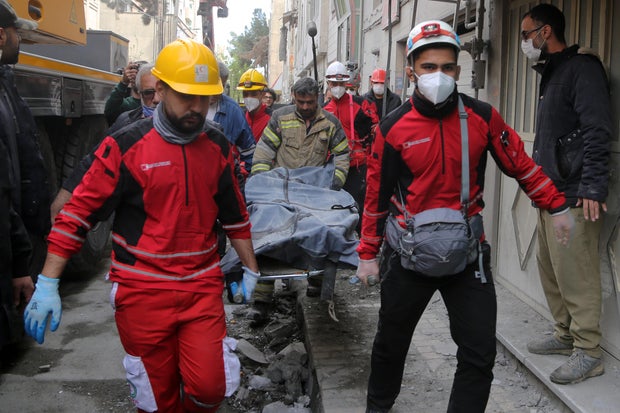
Israel launched a new wave of strikes on Iran and threatened on Friday that its attacks “will escalate and expand” after President Trump claimed talks on ending the war were “going very well” and gave Tehran more time to open the Strait of Hormuz, though there have been no signs of Iran backing down.
The United States has offered Iran a 15-point proposal for a ceasefire that includes it relinquishing control of the strait, but at the same time has ordered thousands more troops to the region — possibly in preparation for a military attempt to wrest the waterway from Iran’s tight grip.
Fatemeh Bahrami/Anadolu/Getty
Air raid sirens sounded in Israel, meanwhile, as the military said it was working to intercept Iranian missiles in what has been a daily occurrence. Israel’s Defense Minister Israel Katz said Iran “will pay heavy, increasing prices for this war crime.”
“Despite the warnings, the firing continues,” Katz said. “And therefore attacks in Iran will escalate and expand to additional targets and areas that assist the regime in building and operating weapons against Israeli citizens.”
Israel’s military said its attack on Friday targeted sites “in the heart of Tehran” used by Iran to produce ballistic missiles and other weapons. It also hit missile launchers and storage sites in western Iran.
CBS/AP
UAE says 6 Iranian missiles, 9 drones intercepted on Friday
The United Arab Emirates Ministry of Defense reported the interception of six Iranian ballistic missiles and nine drones on Friday, bringing the total number of such weapons engaged since the beginning of the Iran war to 393 missiles and more than 1,830 drones.
The UAE has been targeted with more Iranian weapons than any other Gulf state, and has fended off nearly as many missiles as Israel during the war, according to data compiled by the independent Institute for National Security Studies in Israel.
At least 10 people have been killed by the strikes, often by falling debris, in the UAE, including two members of the country’s armed forces.
By Tucker Reals
U.S. appears to have dropped anti-tank mines in Iranian village near Shiraz, analysts say
The U.S. appears to have dropped anti-tank mines over a village in southern Iran, the open source research group Bellingcat reported Thursday, as images posted on social media appear to show American BLU-91/B scatterable anti-tank landmines.
Iranian state media reported that “explosive packages” slightly larger than tuna cans had been dropped by aircraft over the southern suburbs of Shiraz, and that some had exploded after being handled.
Several people were killed by the devices, Iranian state TV said, and it urged members of the public to report the items’ locations to authorities and not touch them.
Bellingcat cited three independent weapons experts as saying the munitions shown by Iranian state media appeared to be BLU-91/B mines, delivered by American Gator anti-tank mine systems. It noted that the U.S. is the only party in the Iran war known to have Gator Scatterable Mines, the system that uses the BLU-91/B devices.
By Haley Ott
Saudi Arabia says 6 missiles, 6 drones launched at kingdom as Iran continues targeting Gulf states
Saudi Arabia’s Defense Ministry said Friday that it had intercepted two ballistic missiles, while four others fell into the sea off the country’s coast or in uninhabited areas, amid Iran’s continuing attacks on Persian Gulf states.
The ministry said at least six drones were also intercepted in or near the capital Riyadh, “with interception debris falling in the vicinity of one of the military sites with no injuries.”
By Tucker Reals
German foreign minister says direct U.S.-Iran talks “apparently due to take place fairly soon” in Pakistan
German Foreign Minister Johann Wadephul told public broadcaster Deutschlandfunk Friday that a direct meeting between U.S. and Iranian officials “is apparently due to take place fairly soon at short notice in Pakistan.”
After Iranian officials confirmed indirect correspondence with the Trump administration earlier in the week, including a set of proposed terms for a peace deal handed to Tehran by an intermediary, which Iranian officials rejected, Wadephul called the prospects of a direct meeting the “first signs of hope and confidence.”
“Apparently, initial positions have already been exchanged in writing via third parties,” Wadephul said, adding that he did not know “who facilitated all of this,” according to German news agency DPA.
He suggested U.S. Secretary of State Marco Rubio, in Paris on Friday for a meeting with his fellow G7 foreign ministers, might “perhaps also set that out a little more precisely today.”
By Tucker Reals
Kuwait says major ports struck as Iran continues attacks on U.S. allies in Gulf
Kuwait’s government said the country’s Mubarak Al-Kabeer Port, still under construction as part of China’s Belt and Road Initiative, was damaged Friday as Iran continued its attacks on energy infrastructure belonging to America’s Persian Gulf allies.
A statement issued by Kuwait’s Ministry of Public Works said port infrastructure “was subjected to a double attack this Friday morning by hostile drones and cruise missiles,” with material damage but no casualties reported.
Officials said the Shuwaikh Port in Kuwait City also sustained damage in Iran’s latest assault.
The extent of the damage done to the ports was not immediately clear.
By Tucker Reals
U.N. rights chief demands justice and accountability over likely U.S. strike that hit Iran school
Iran’s foreign minister on Friday branded a deadly strike on an Iranian school on the first day of the U.S.-Israeli war against his country a “calculated” assault by the U.S.
Addressing an urgent debate in the United Nations Human Rights Council focused on the Feb. 28 strike on an Iranian elementary school in Minab, Abbas Araghchi said “more than 175 students and teachers were slaughtered in cold blood” in a “calculated, phased assault.”
The strike, he said in a video address, “was a war crime and a crime against humanity, one that demands unequivocal condemnation by all, and unambiguous accountability for the culprits.”
U.N. rights chief Volker Turk said the bombing evoked “visceral horror.” He called for “justice” for “those who carried out the attack to investigate it promptly, impartially, transparently and thoroughly.”
“Senior U.S. officials have said the strike is under investigation,” he said, calling for the findings to be made public.
A preliminary U.S. assessment suggests the U.S. is “likely” responsible for the strike, but did not intentionally target the school and may have hit it in error, possibly due to the use of dated intelligence which wrongly identified it as part of an Iranian military installation, a person briefed on the U.S. intelligence told CBS News on March 9.
President Trump initially suggested Iran itself could have been responsible, despite the strike being carried out with Tomahawk missiles, which Iran does not have.
CBS/AFP
Iran accuses Trump of lying about Strait of Hormuz as it forces 3 ships to turn around in key waterway
Iran’s powerful Islamic Revolutionary Guard Corps accused President Trump of making “false statements” about diplomacy between the countries yielding an agreement for some ships to safely transit the Strait of Hormuz, insisting it still had full control of the vital shipping lane.
Mr. Trump said Iran had given him the “present” this week of allowing “eight big boats of oil” to transit the strait, suggesting it was a good will gesture to demonstrate willingness to negotiate an end to the war.
“This morning, following the false statements of the corrupt U.S. president claiming that the Strait of Hormuz is open, three container ships of different nationalities moved toward the designated corridor for authorized vessel traffic, but were turned back after warnings from the IRGC Navy,” the Guard Corps said in a social media post.
It said the IRGC Navy reiterated that “the Strait of Hormuz is closed and that any traffic through it will face a severe response,” and that the “passage of any ship ‘to and from’ ports belonging to allies and supporters of the Zionist-American enemies, to any destination and via any corridor, is prohibited.”